
1
2
Step 2: Create a new master item
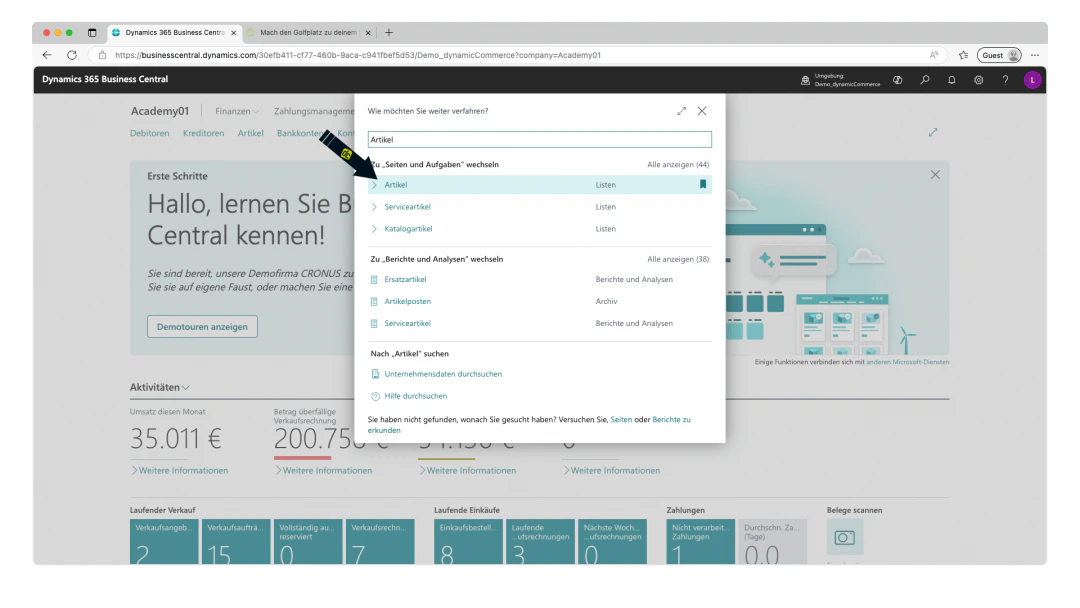
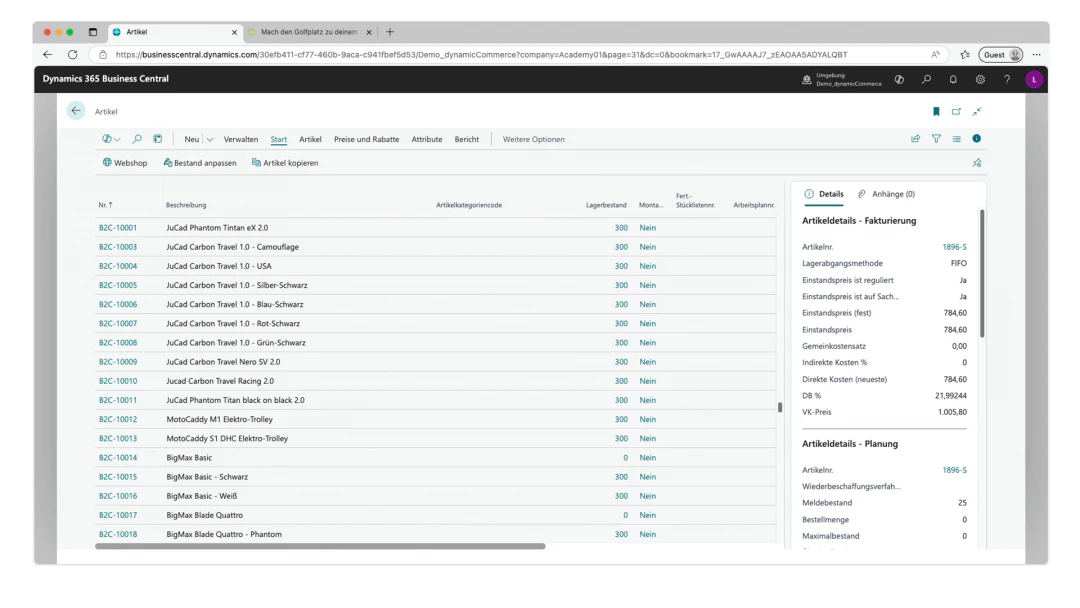
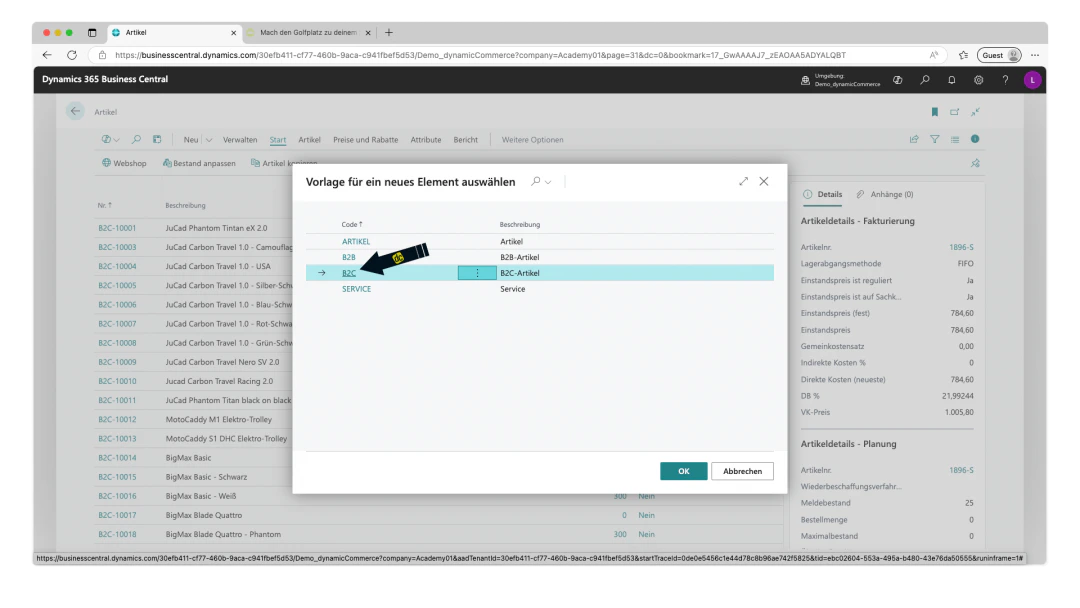
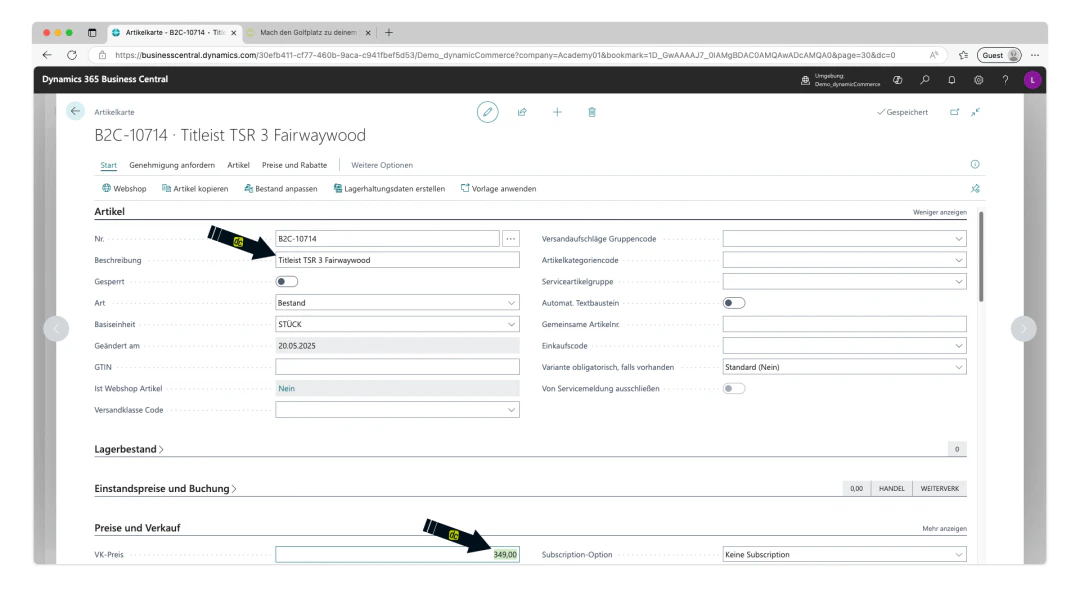
Skip this step if the master item already exists.In the ribbon of the item list, click New.Select an item template if required. In this example we use the template for b2c items. The available templates may have different names in your system.On the item card of the master item, you can now maintain the master data of the item as usual.In our example, we only maintain “Titleist TSR 3 Fairwaywood” as the description and the sales price of €349.This means the master item is essentially already created. Of course, various other functions relevant for the webshop can still be configured or linked there, such as shipping classes and the settings for our Microsoft Dynamics ERP app Shipping Costs.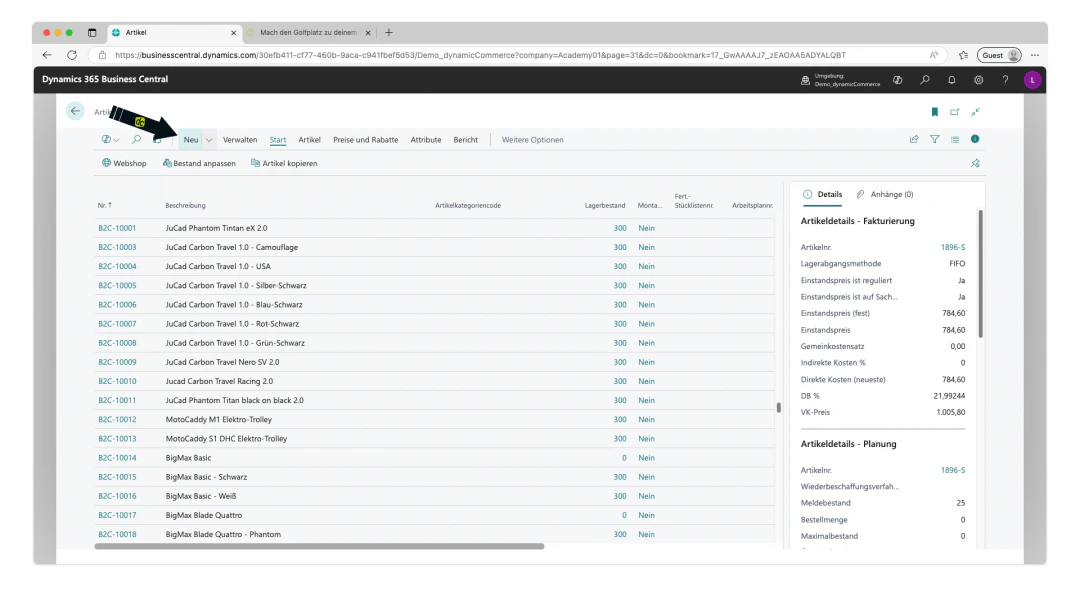
3
Step 3: Create webshop item
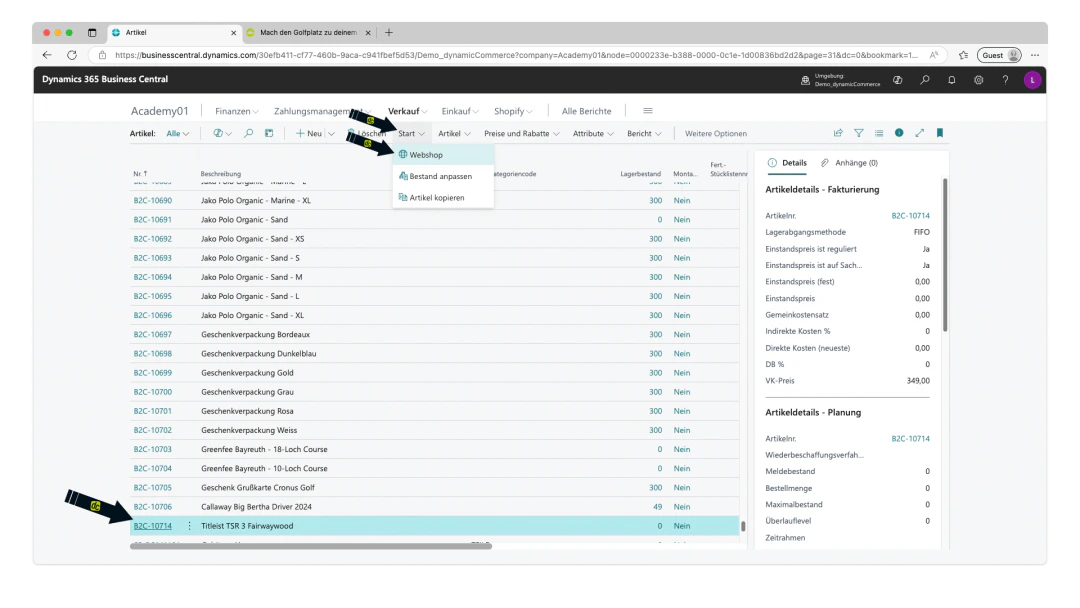
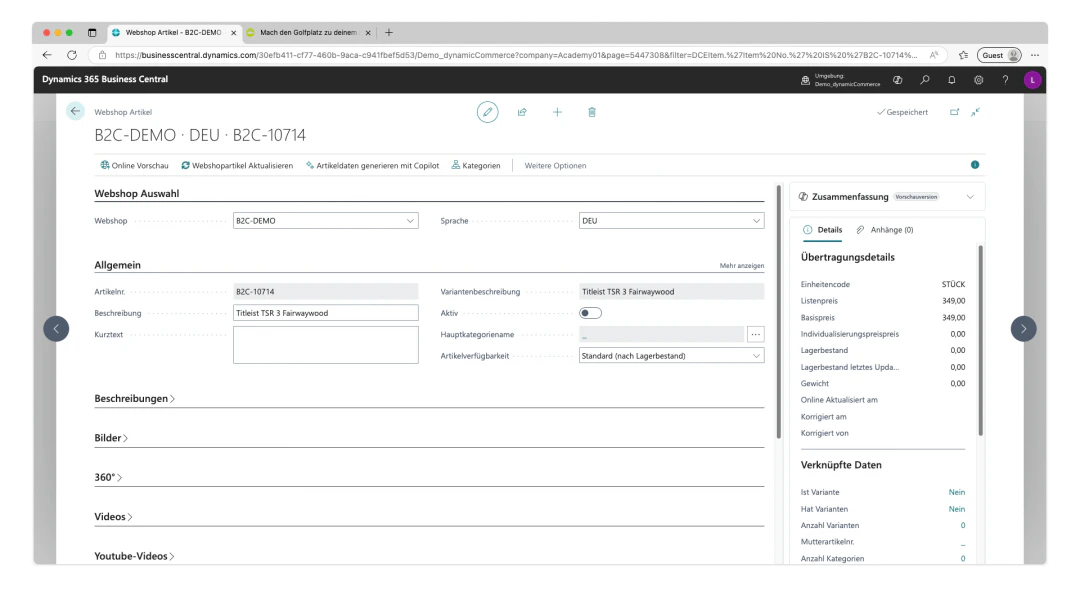
Clicking “Webshop” directly in the ribbon of the master item card creates the webshop item immediately.Alternatively, you can create the webshop item from the item list. Select the desired master item and open the webshop function in the Home ribbon.Both paths result in the empty webshop item card now being open.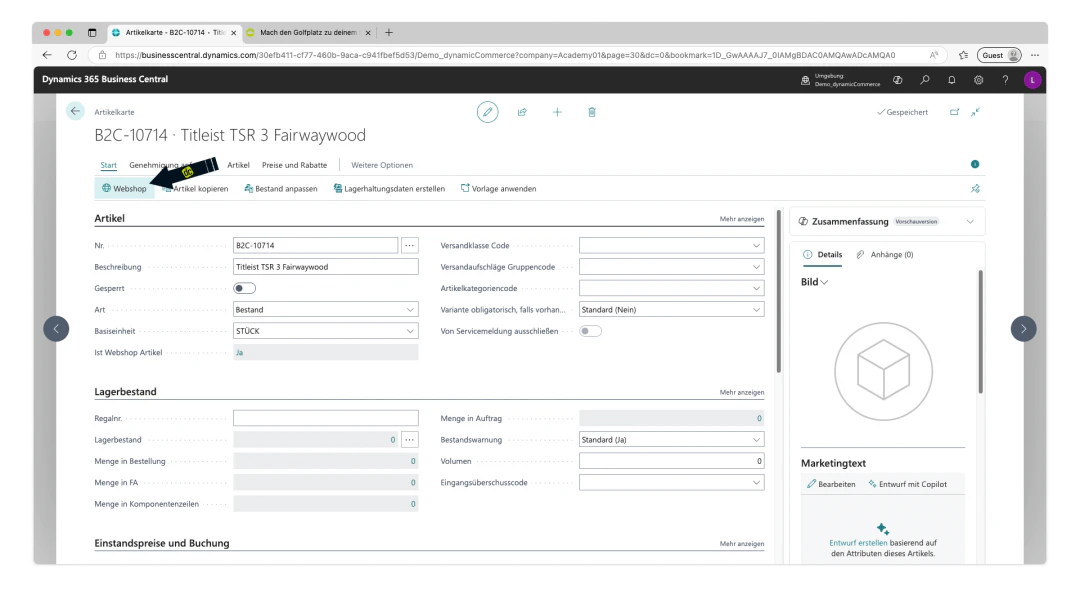
4
Step 4: Webshop selection
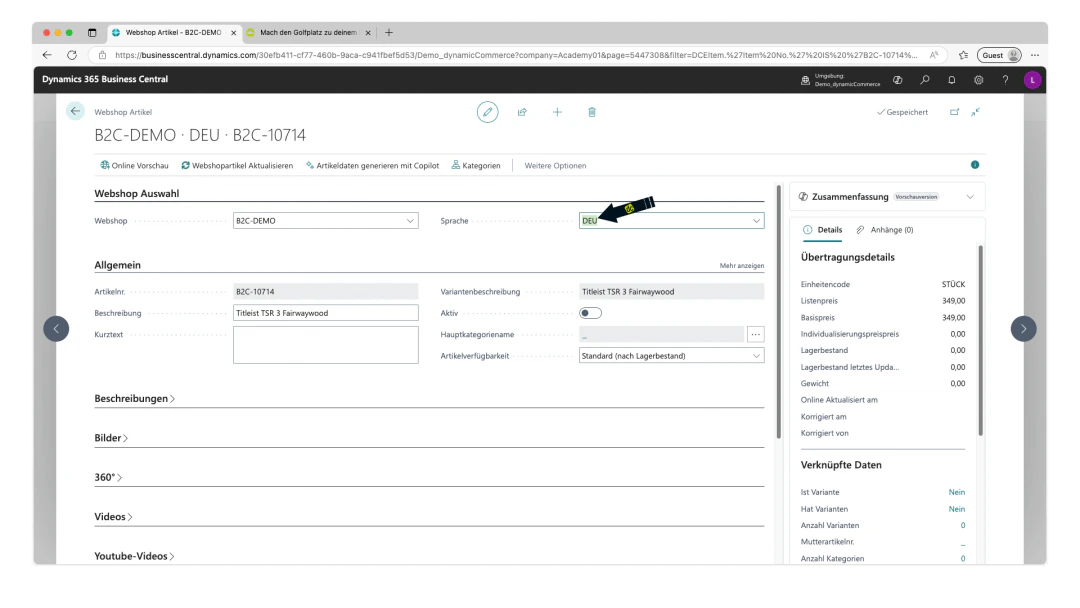
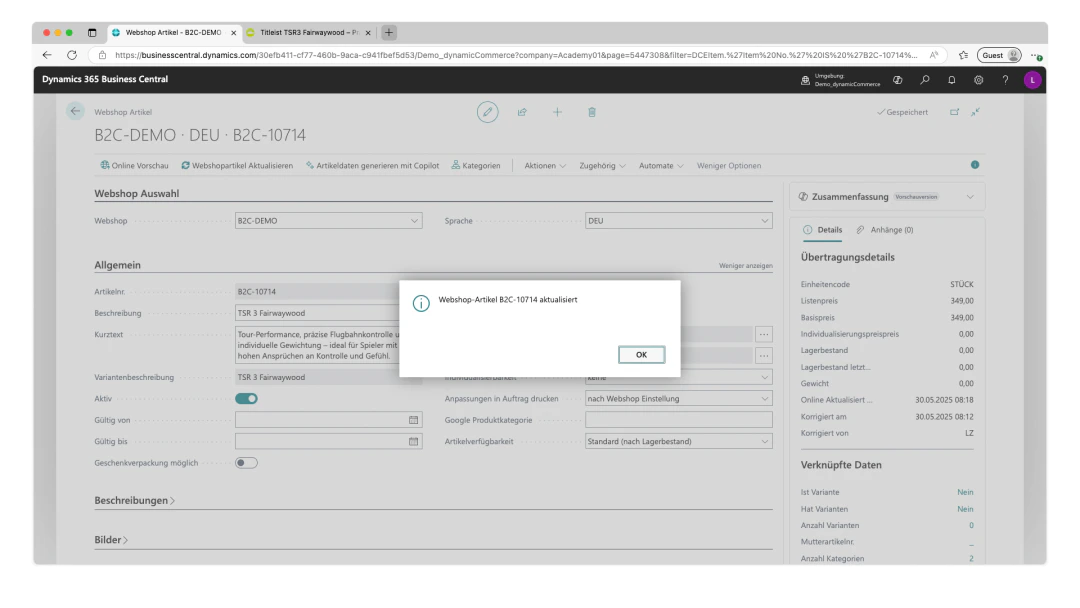
Once on the webshop item card, you should first select the webshop and the webshop language for which the webshop item is to be created under the “Webshop selection” section.Select the desired webshop in the Webshop field. Then define the webshop language in the Language field.By default, the default webshop from the webshop setup and the default language of this webshop are selected there.We explain the webshop setup to you here. We also show you here how to set the default language for the webshop.In our example, we have selected the webshop “B2C-DEMO” and the language “DEU”. This is the German demo of our b2c shop “CRONUS GOLF”.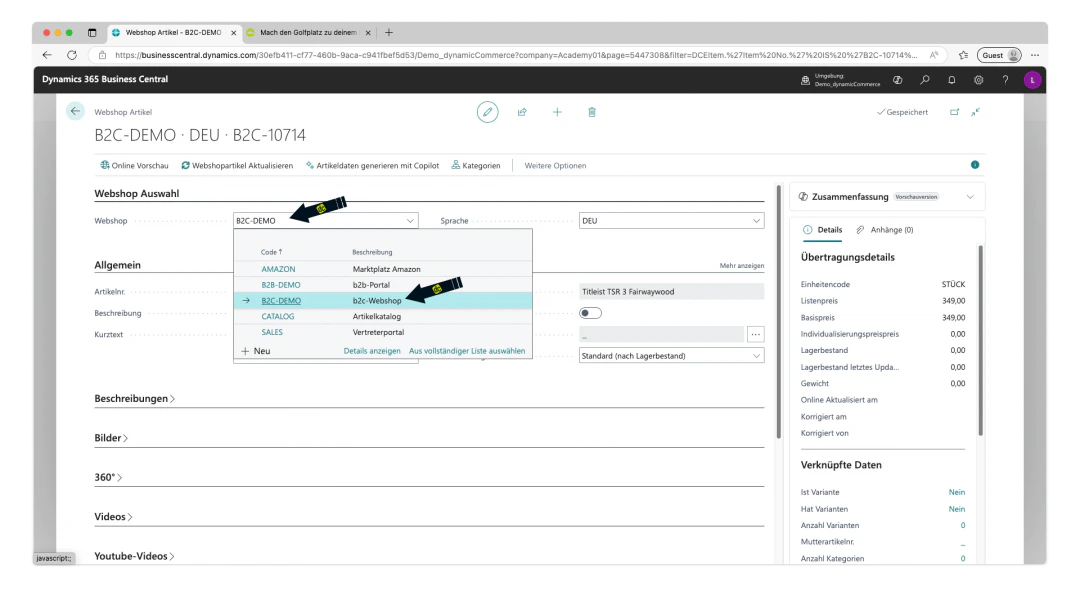
5
Step 5: Define general data
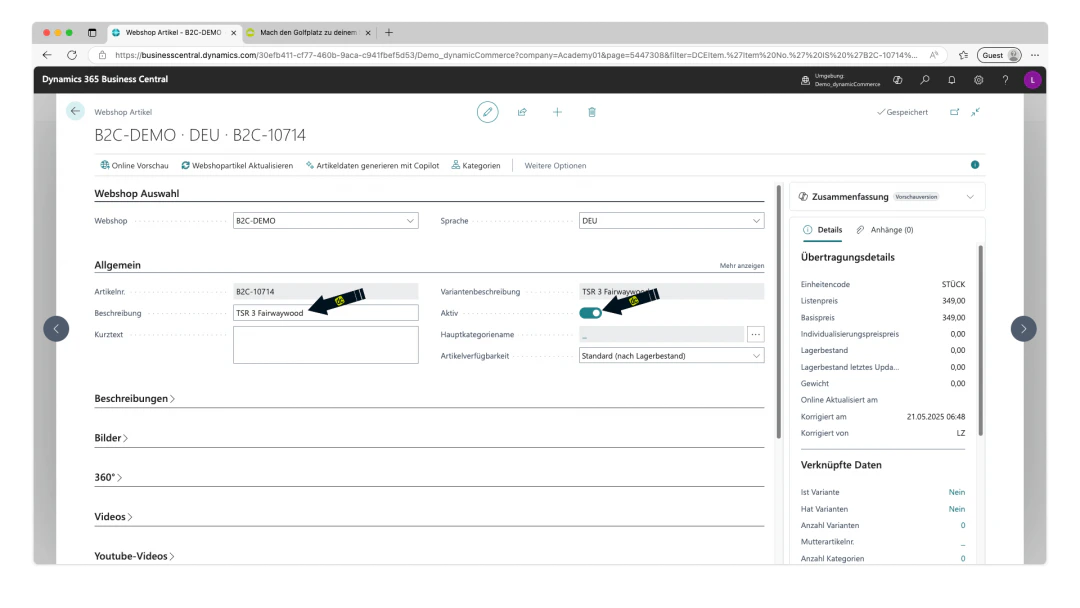
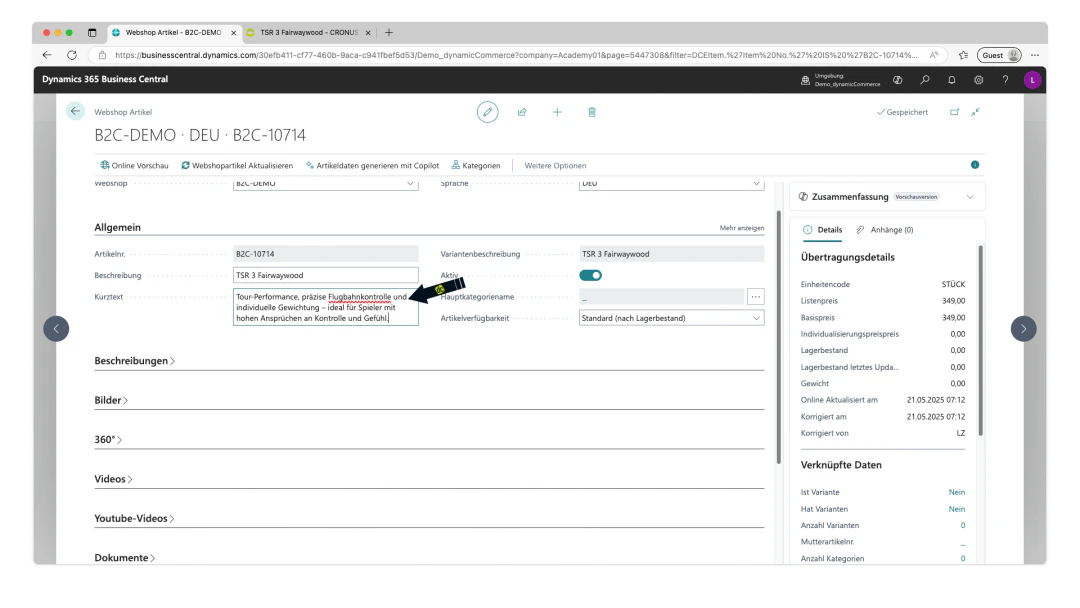
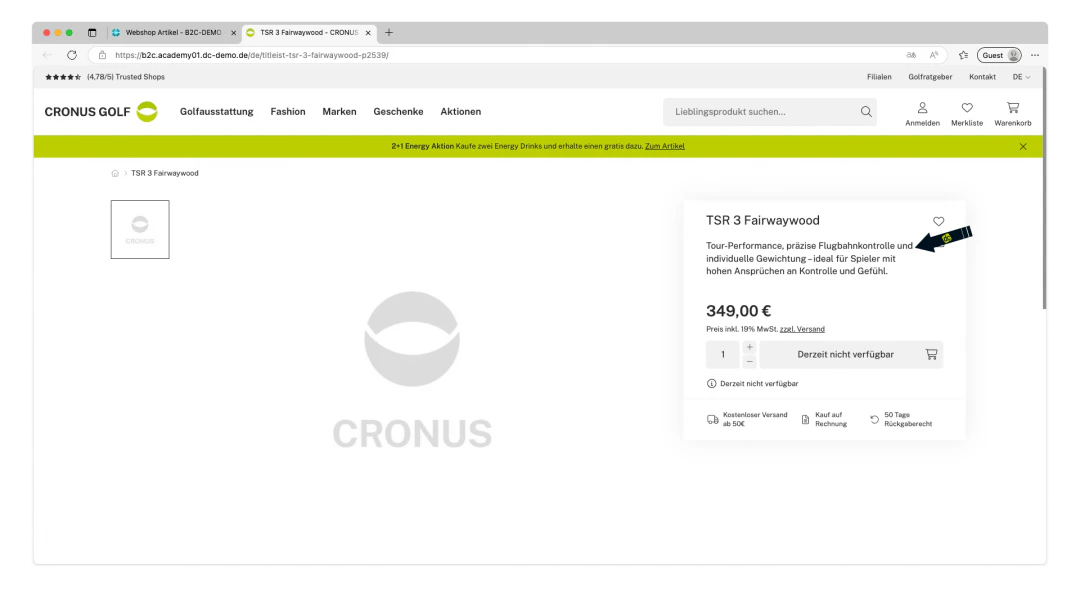
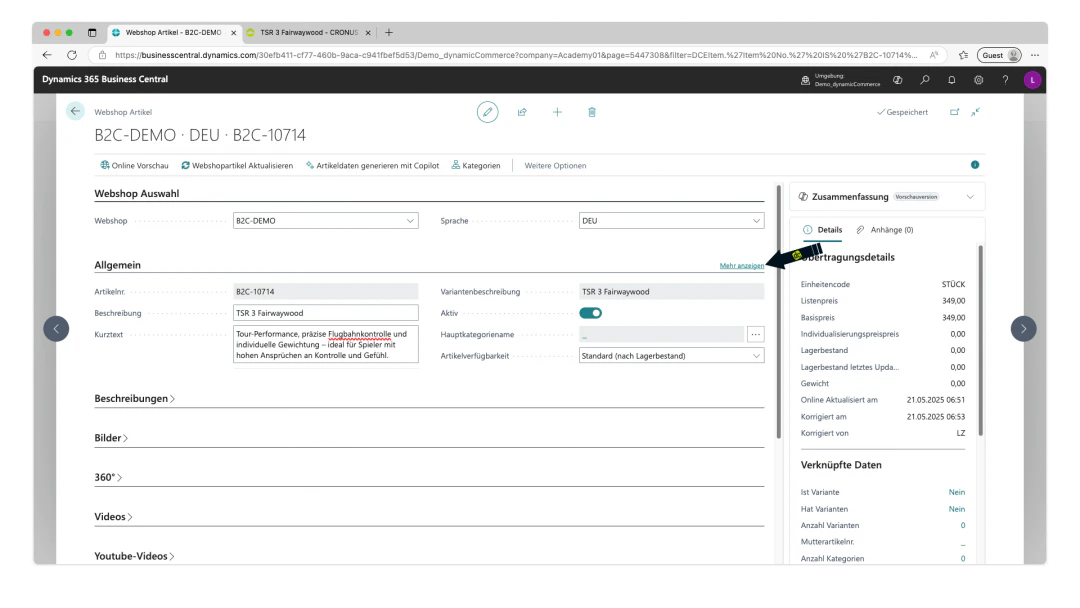
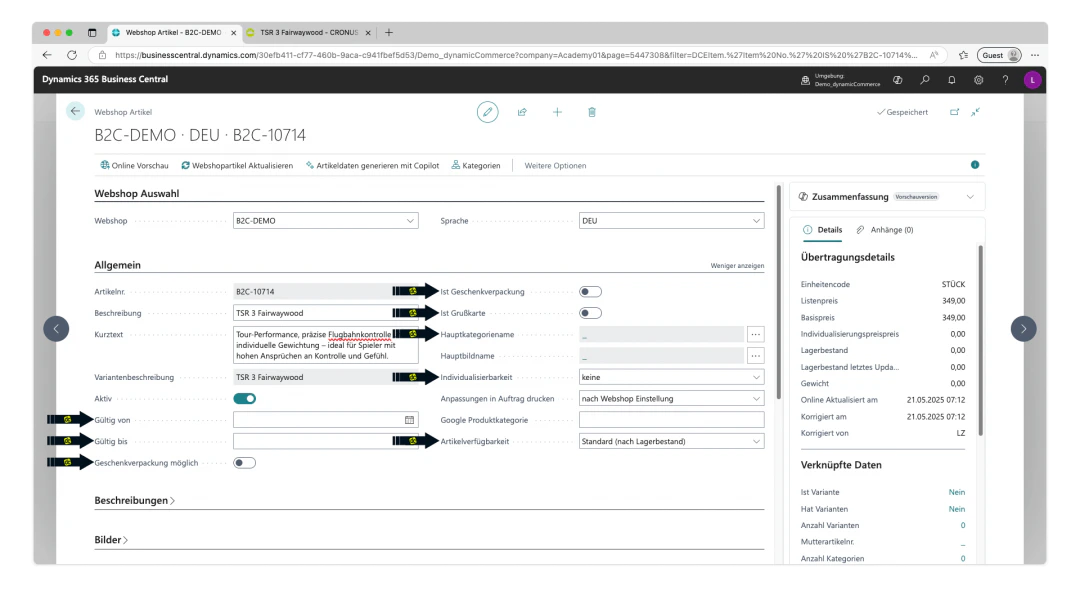
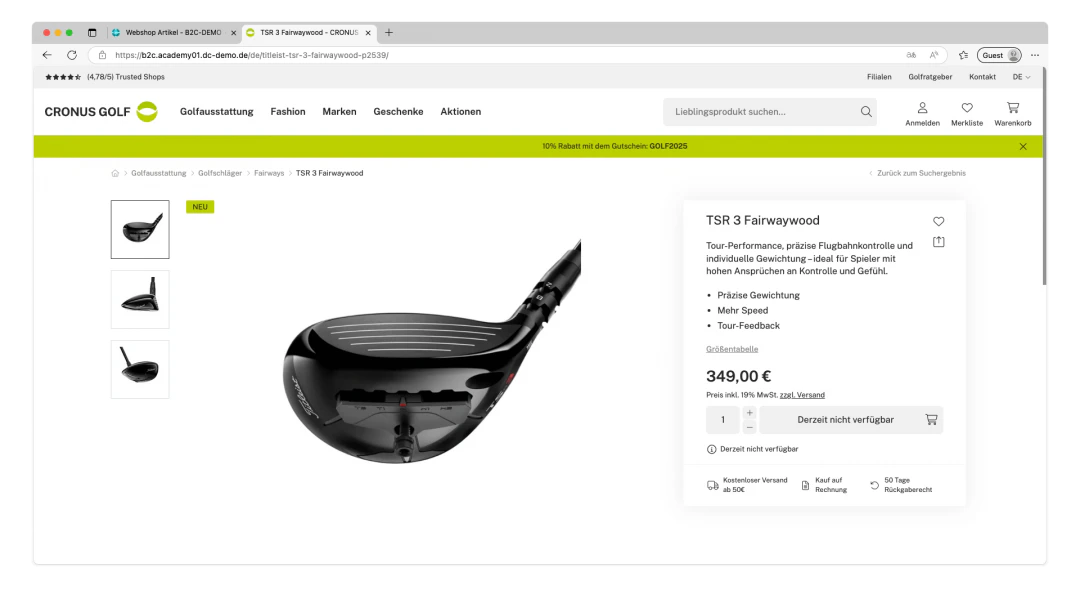
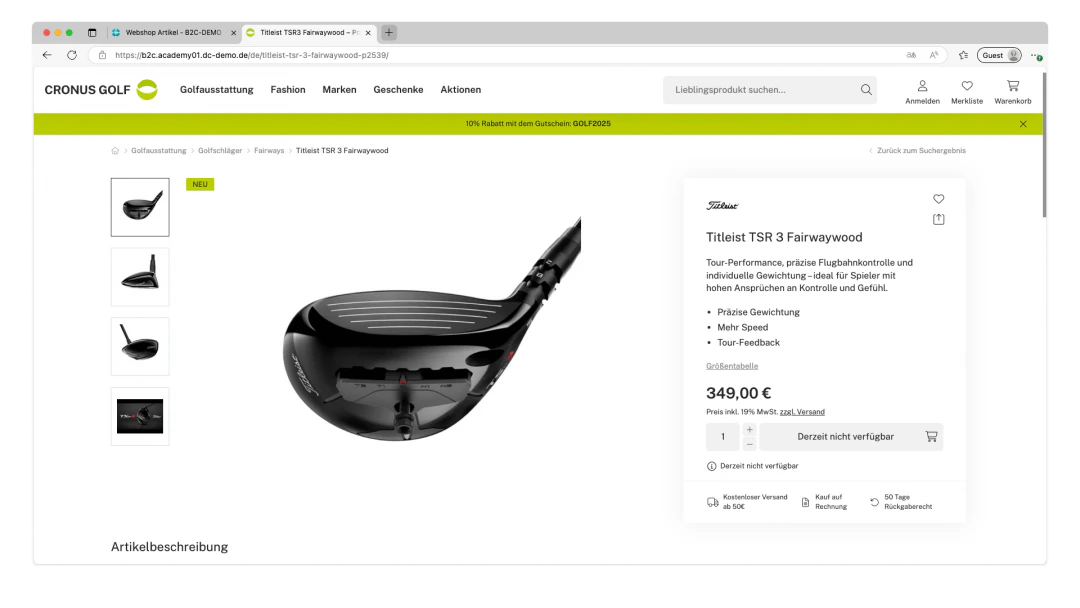
The general item data can be found in the “General” section.The “Description” and “Item No.” fields are already filled with data from the master item.In order for the item to be displayed in the webshop at all, it must first be set active by activating the “Active” checkbox.In our example, we set the item active and adjust the description - i.e. the display name - of the webshop item. We then also select a suitable short description. In our current demo layout, this is displayed directly below the item name in the webshop, as can be seen in the screenshots below.By clicking “Show more” on the section heading, additional fields of the “General” section can be displayed.The following important settings are located there:- Item validity: with the “Valid from” and “Valid to” fields, the validity of the webshop item can be restricted to a specific period. By clicking on the fields, you can conveniently select a date in the calendar that opens. The webshop item is then only active from or until the selected date and is no longer displayed in the webshop before or after that.
- Gift wrapping: with the “Gift wrapping possible” checkbox, you can select whether the item can be sent as a gift. However, gift wrapping must be active as a webshop item and marked with the “Is gift wrapping” checkbox. You can find detailed instructions on gift wrapping here.
- Greeting cards: with the “Is greeting card” checkbox, the webshop item can be marked as a greeting card. You can find instructions on how to create a greeting card that can be customized by customers here.
- Main category name: The main category of the webshop item is displayed here. If a webshop item is in multiple categories, the main category can also be selected there. More on this in the next step.
- Customizability: This drop-down can be used to configure the extent to which the webshop item can be customized. More on this here.
- Item availability: This drop-down allows you to make a selection. With the options “Yes” or “No”, the webshop item is always or never available, regardless of inventory. With the “By inventory” option, the webshop item is only available if it is in stock. In addition, the “Default” option can also be selected, in which case the availability is taken from the webshop.
6
Step 6: Assign the webshop item to a webshop category
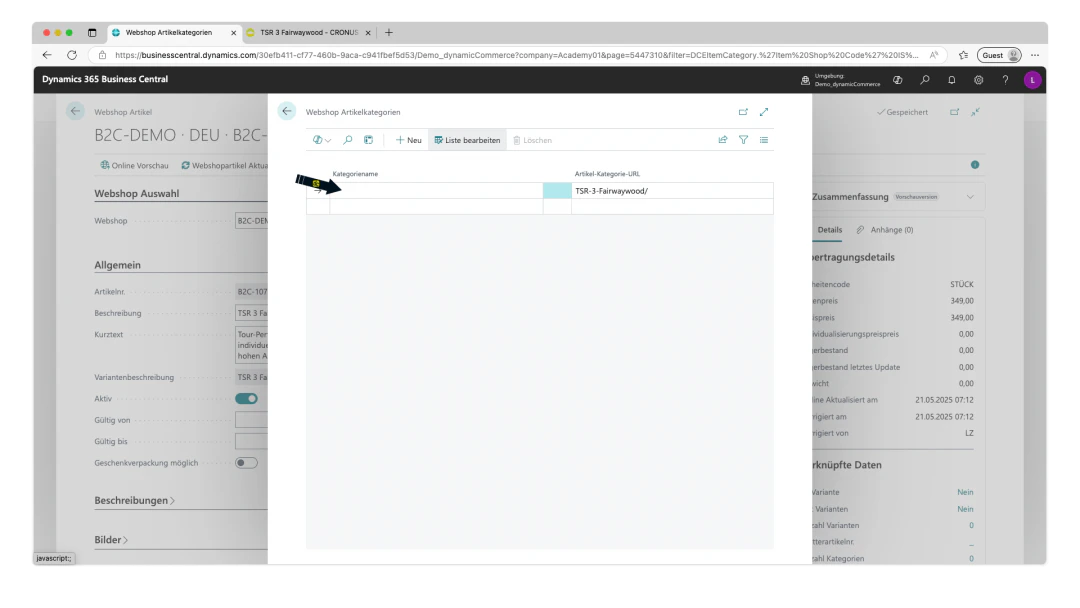
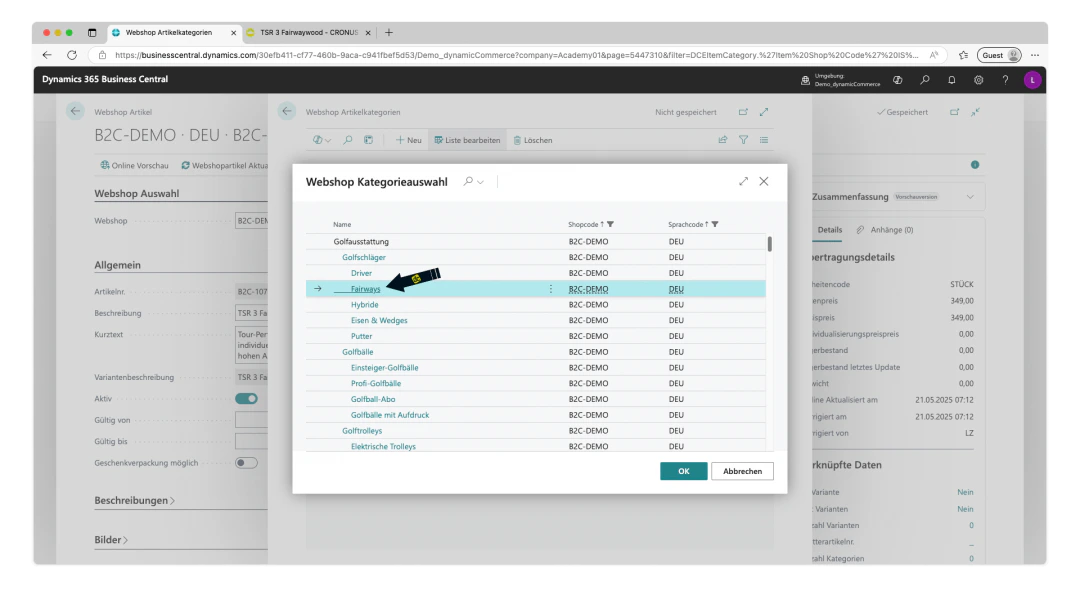
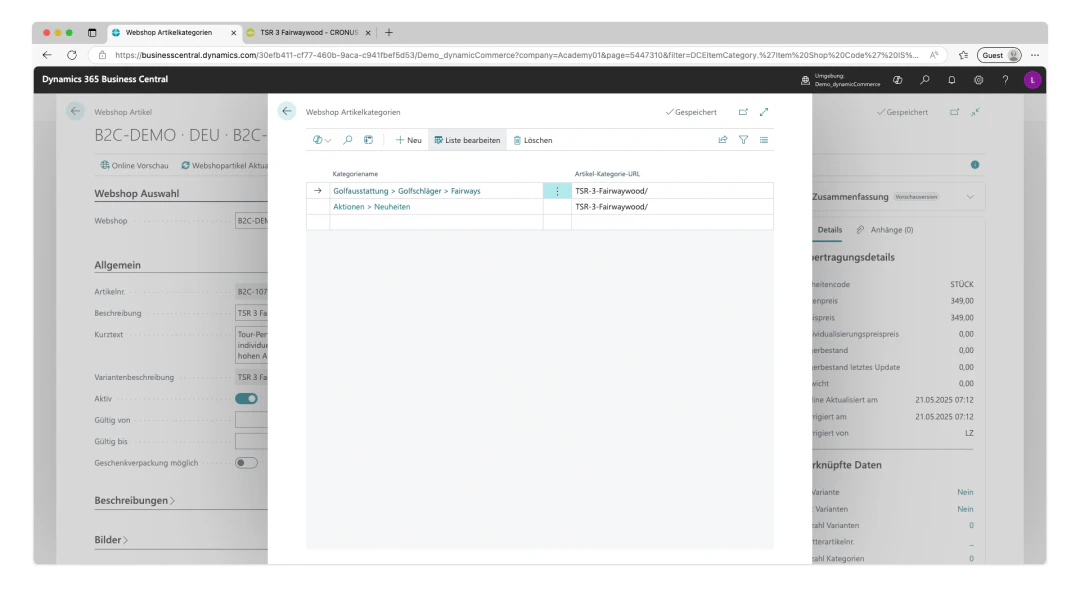
In order for your created webshop item to also be displayed in the webshop categories, the item must be assigned to them.The webshop categories must be created beforehand in the webshop language. We show you here how this works.In the ribbon of the webshop item card, click Categories. This opens the Webshop Item Categories list.When you click on an empty row in the “Category name” column there, another menu opens in which the desired category can be selected. The webshop category selected there is then assigned directly to the webshop item.In our example, we assign the categories “Fairways” and “New Arrivals” to the item and close the “Webshop Item Categories” list again to return to the webshop item card.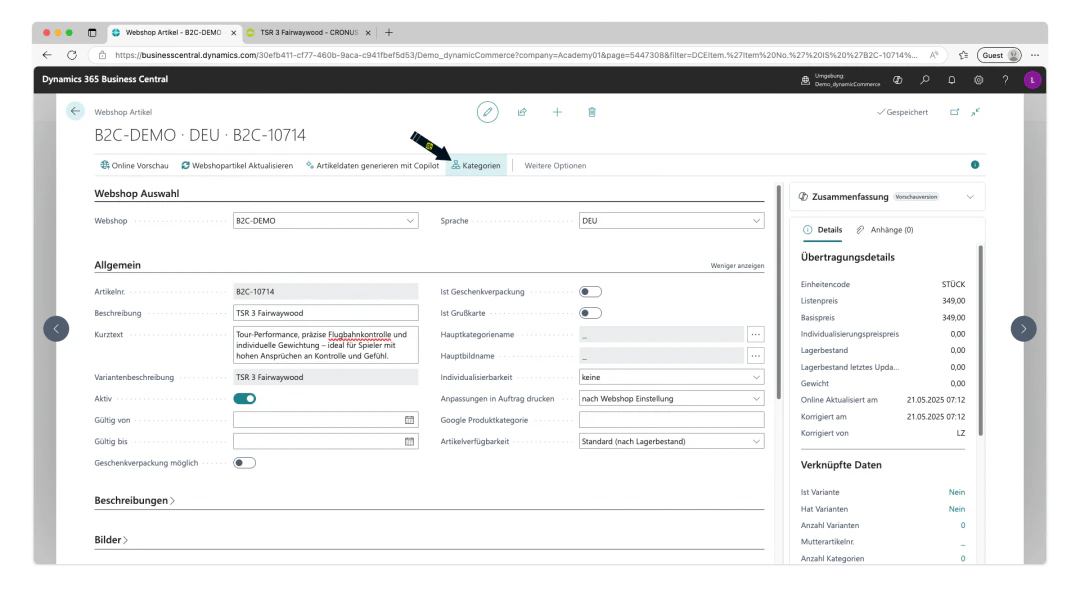
7
Step 7: Create description
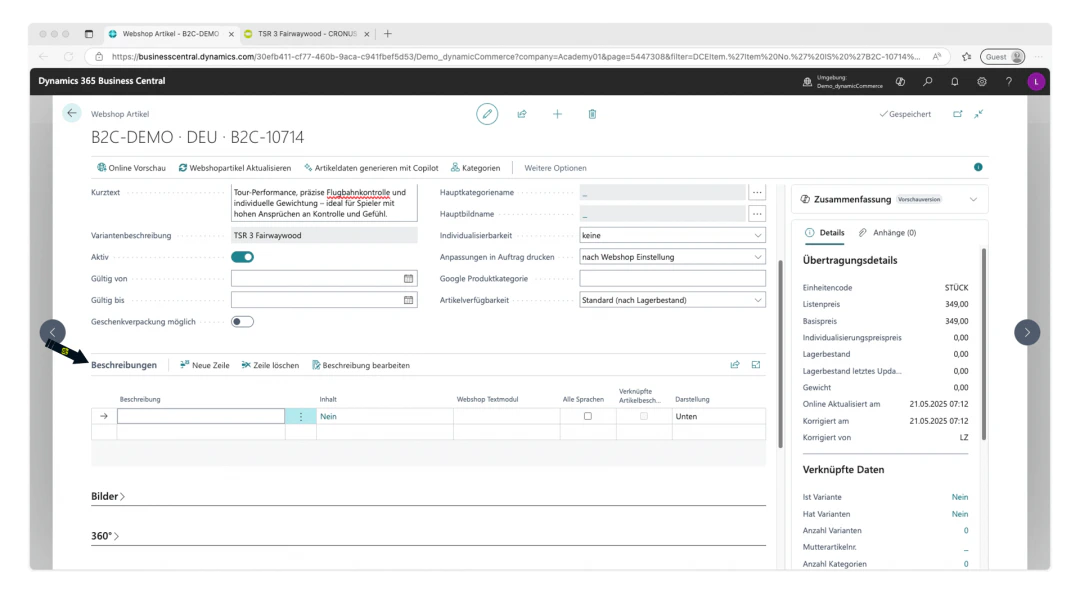
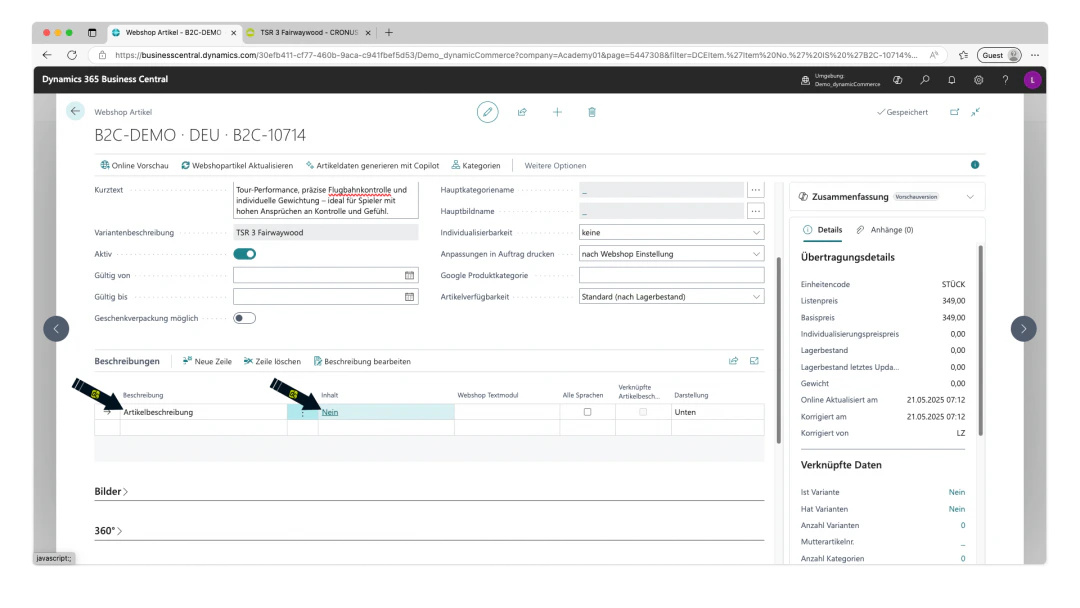
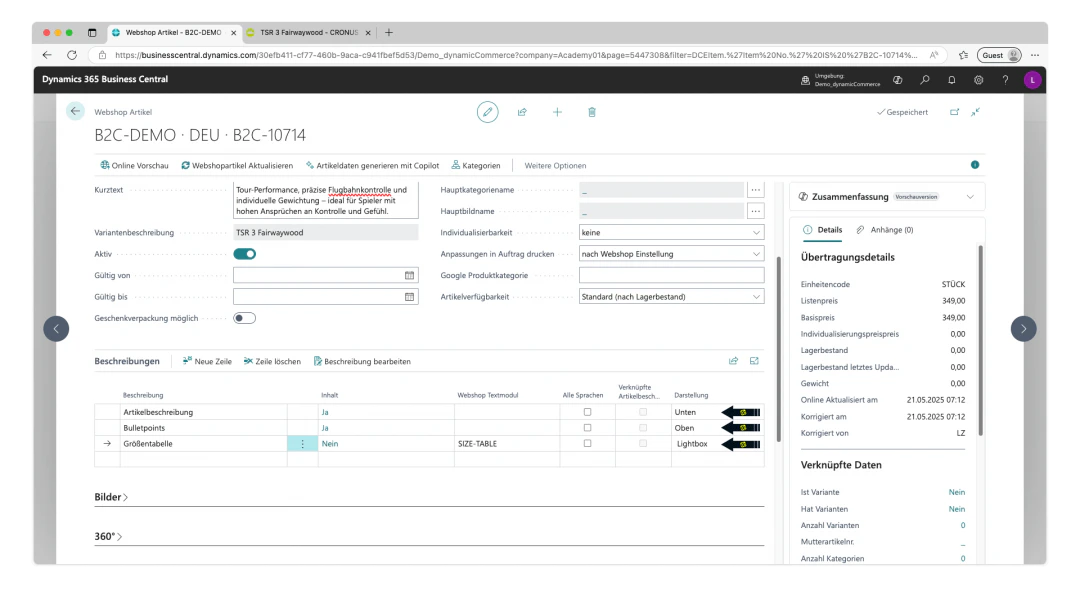
Now it is time to create descriptions for the webshop item.This works on the webshop item card under the “Descriptions” section, which must first be expanded by clicking on the heading.A table with various columns can be seen there:- Description: In the “Description” column, a description for the created description can be maintained. Depending on the configuration, this is also displayed in the webshop, which is why a meaningful description should be chosen.
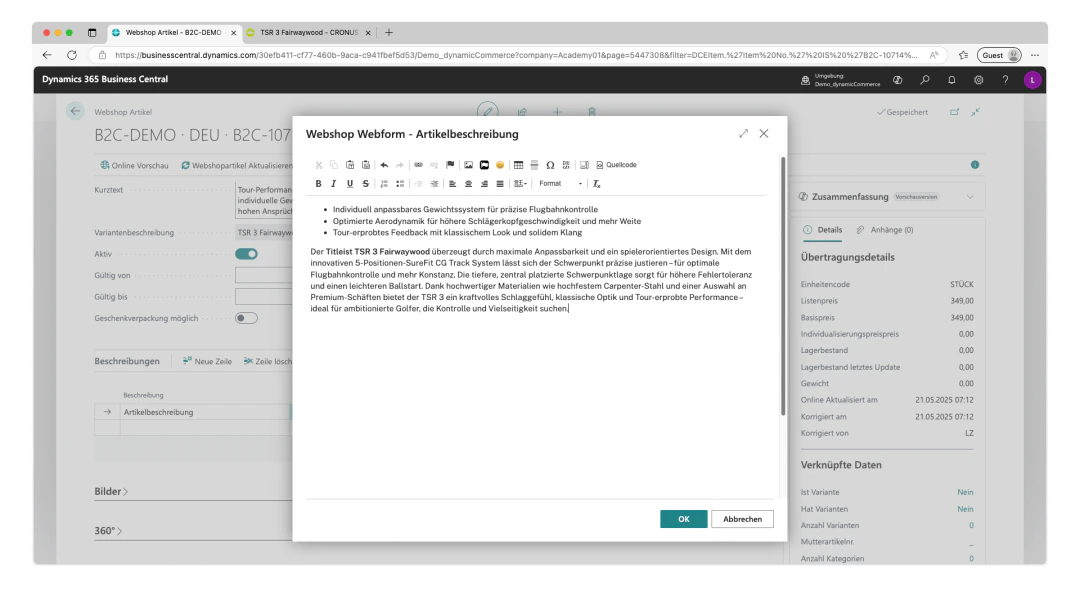
- Content: This column shows whether content - i.e. the actual description text - is maintained for the description. By clicking on the “No” or “Yes” displayed there, the content can be created or edited.
- Webshop text module: By clicking on the respective cell of the “Webshop text module” column, a webshop text module can be assigned to the description instead of content, which then serves as the description text. This is useful for recurring descriptions on the item, such as legal notices for a subscription or a size chart. If a webshop text module is assigned, no content may be maintained for the description. We show you here how to create webshop text modules.
- All languages: With the checkbox in this column, the description can be activated for all webshop languages. This means that the description created here in the German b2c demo shop is also automatically displayed in the English b2c demo shop as soon as you create a webshop item for the same master item for the English b2c demo shop.
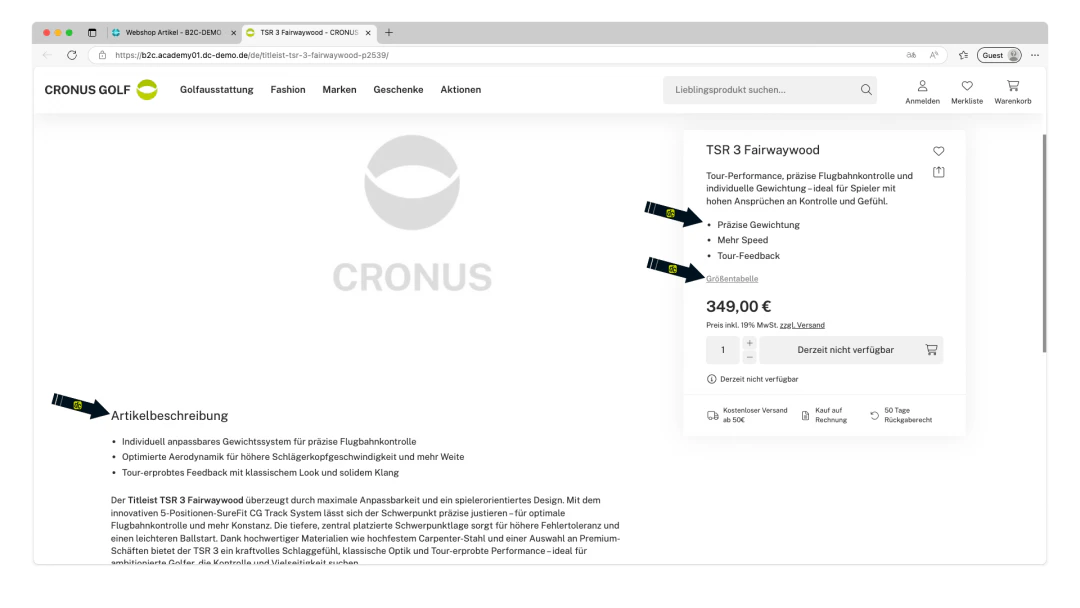
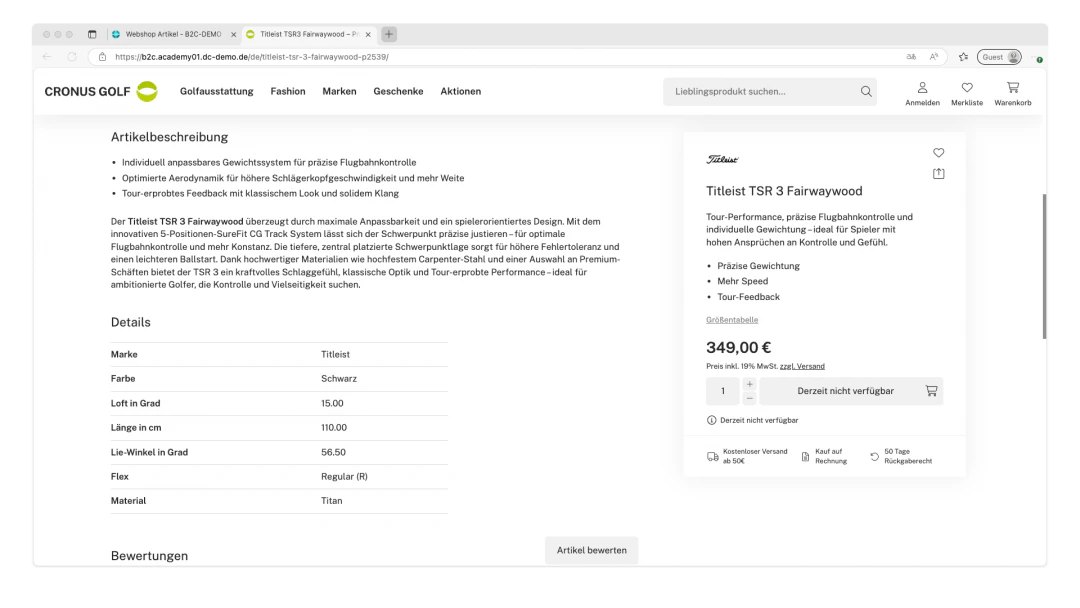
- Display: This drop-down can be used to determine where the created description is displayed on the webshop item. “Bottom” results in the description being displayed below the item, which is well suited for long item descriptions. If “Top” is selected for the display, the description is displayed in the so-called buy box of the item. The “Lightbox” display ensures that a link or a button is created below the item name in the webshop, which is labeled with the text from the “Description” column. When this button is clicked, the description with content opens in a so-called lightbox.
8
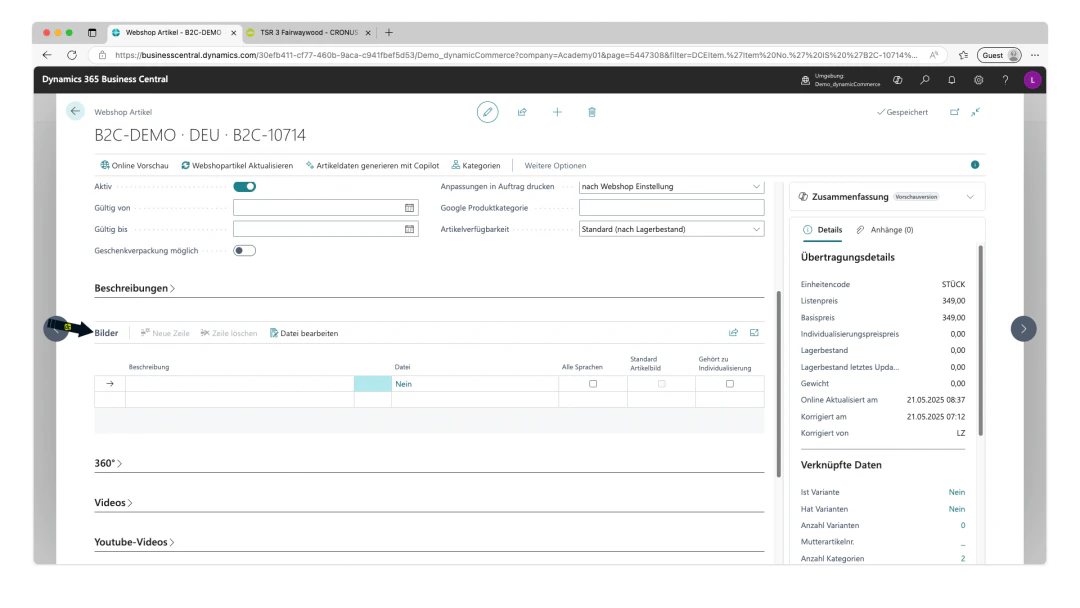
Step 8: Add images
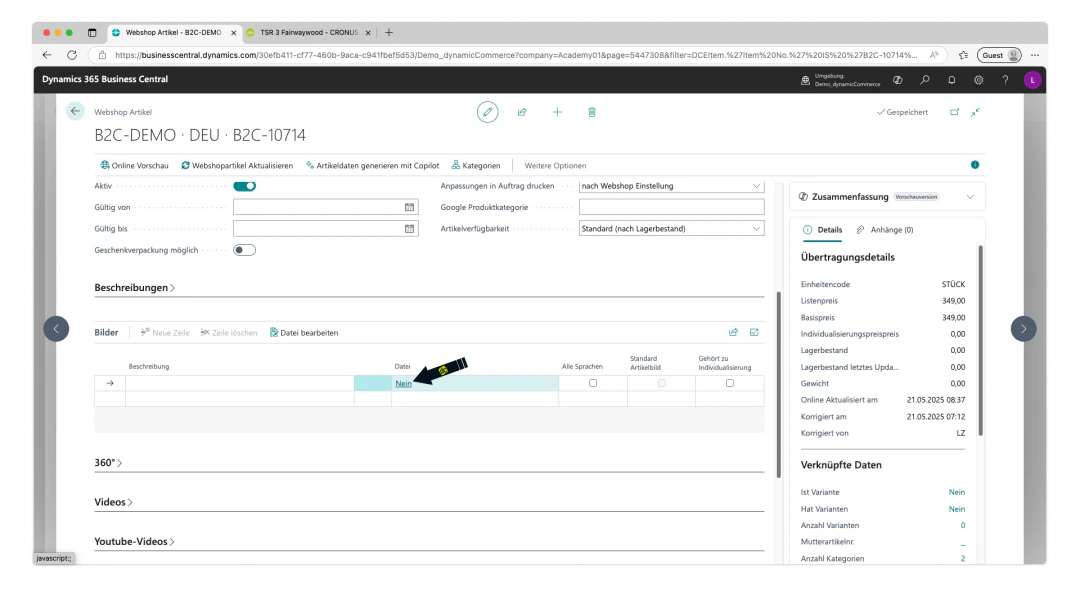
Adding images to the webshop item works on the webshop item card under the “Images” section, which must first be expanded by clicking on the heading.A table with the following columns opens there:- Description: Enter a meaningful image description. dynamic commerce uses it as alt text for search engines and screen readers.
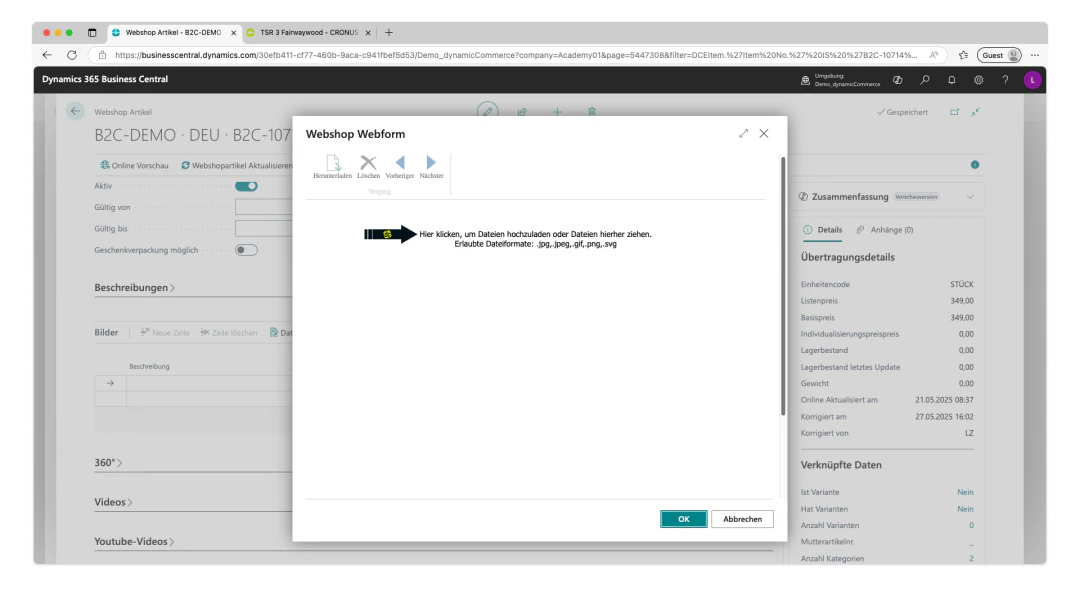
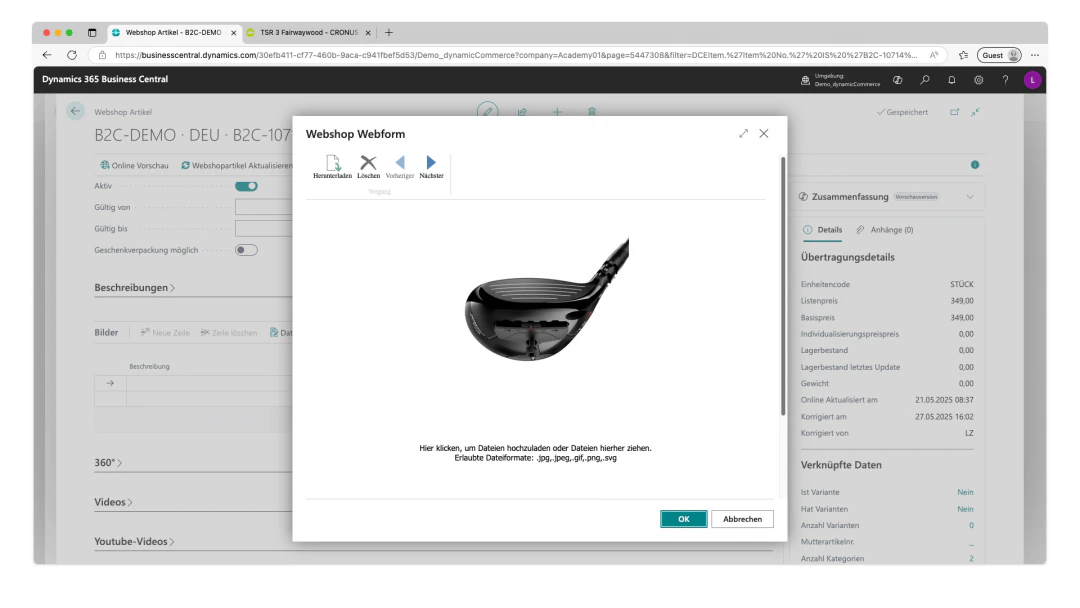
- File: This column shows whether a file - i.e. an image - has already been uploaded. When you click on the “No” or “Yes”, you can upload a new image or replace the existing one.
- All languages: With the checkbox in this column, the image can be activated for all webshop languages. Unlike descriptions, it is generally advisable to activate this checkbox for images so that the images do not have to be maintained for each language.
- Default item image: This checkbox can only be activated on one of the images and then marks this image as the default image of the webshop item. This means that this image is displayed in the item overviews and it is the first image that is displayed when the item is opened.
- Belongs to customization: Only activate if the image belongs to a customization. We explain exactly what this means here.
9
Step 9: Add webshop item attributes
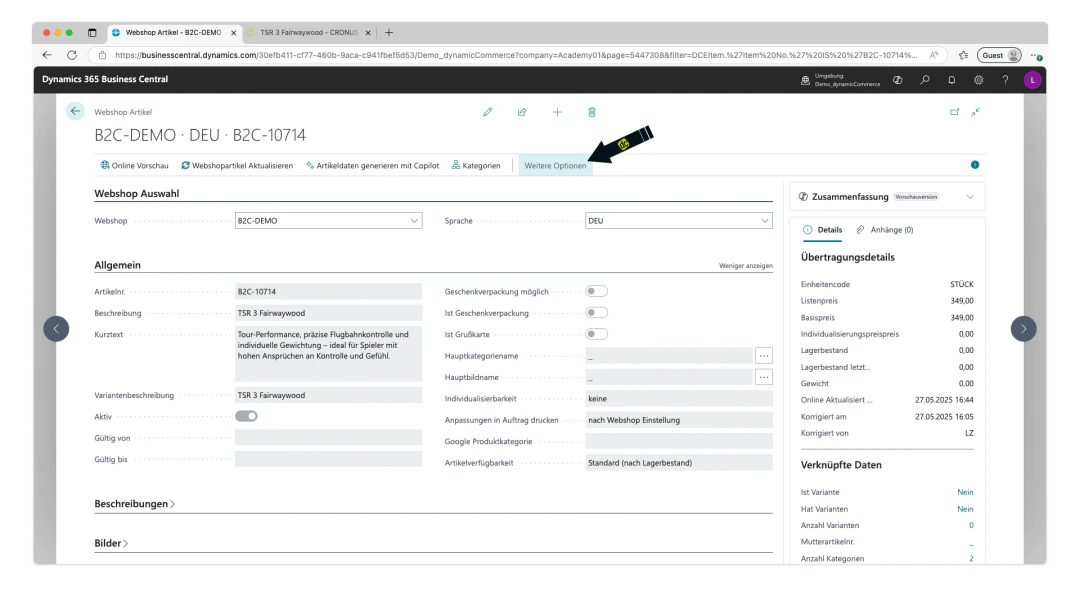
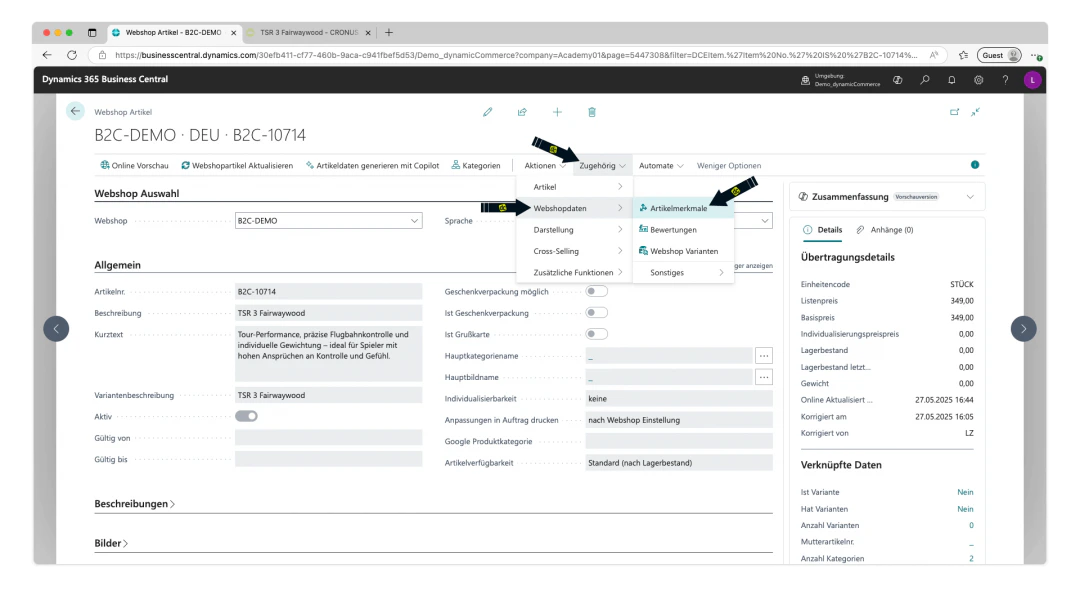
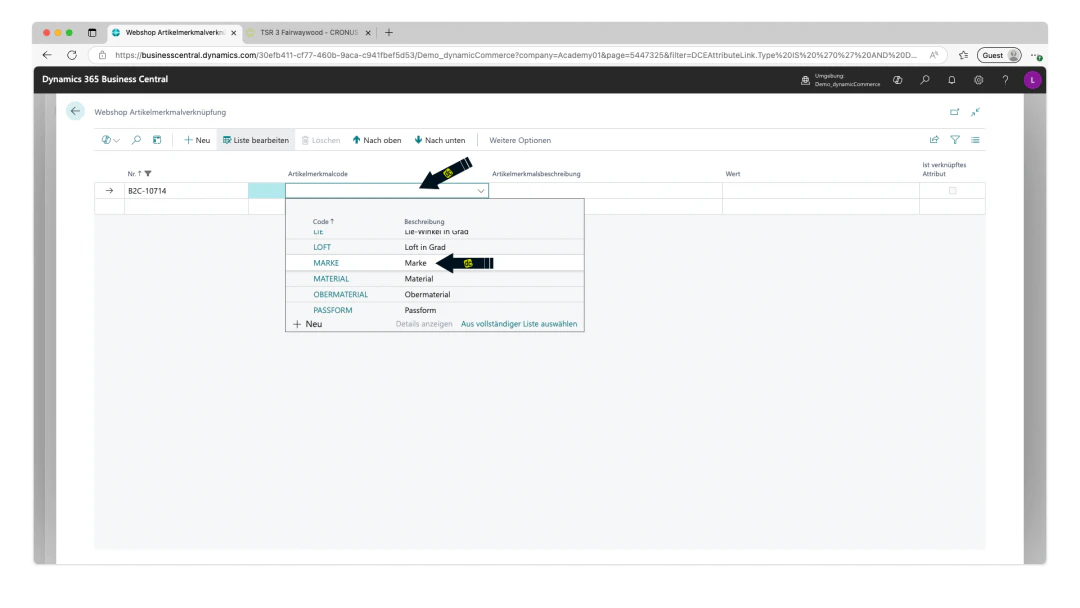
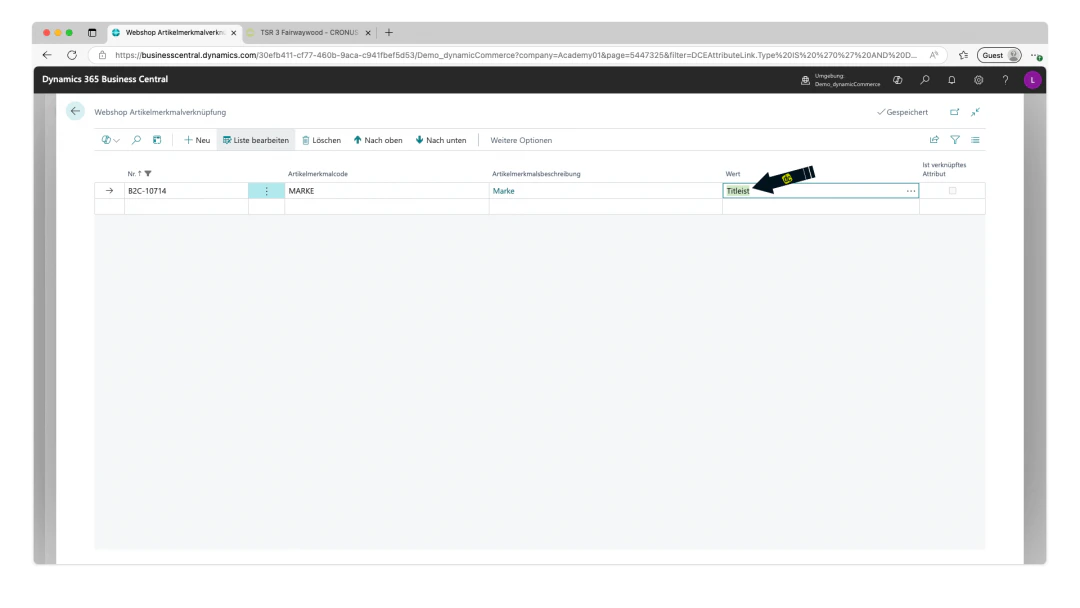
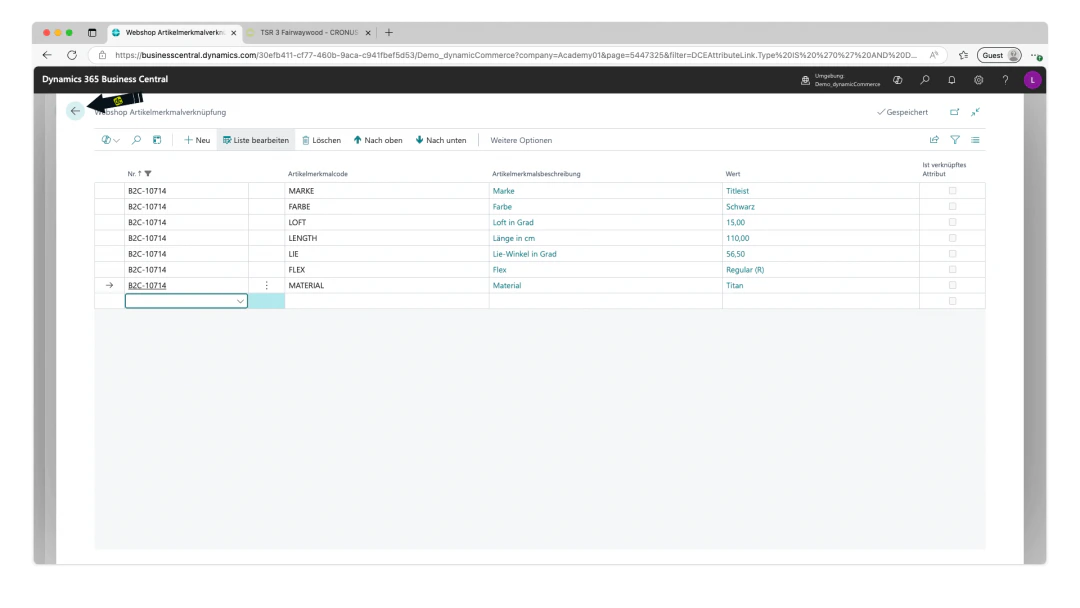
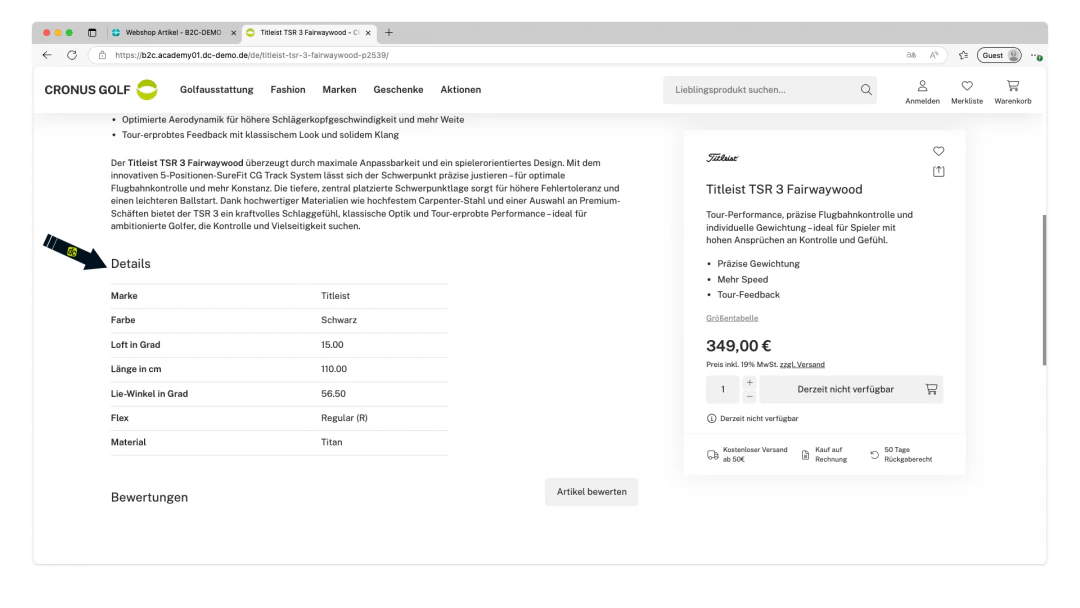
Now you should also add attributes to the webshop item.Webshop item attributes can appear directly on the item. You can also use them as filters for webshop categories.To maintain the attributes on the item, display the additional options on the top ribbon of the webshop item card by clicking the button of the same name.Then click on the newly displayed menu item “Related”, which displays additional menus. In the menu for webshop data, you will find the option “Item attributes”, which must now be clicked.This opens the “Webshop Item Attribute Link” table.In this table, you can now click in the first free cell in the “Item Attribute Code” column, which opens a drop-down in which one of the created attributes can be selected. By clicking on the desired attribute, the item attribute code and the item attribute description are automatically filled for the selected attribute.Then enter the value of the attribute. The available options depend on the configuration of the attribute. Confirm the message Your change might update related records, which could take a while. Do you want to continue? with Yes.In our example, we first select the attribute “Brand” and enter “Titleist” as the value.In addition, we maintain the following attributes with the respective values as just described:- Color: Black
- Loft (loft in degrees): 15
- Length (length in cm): 110
- Lie (lie angle in degrees): 56.5
- Flex: Regular (R)
- Material: Titanium
10
Step 10: Link cross-sellers
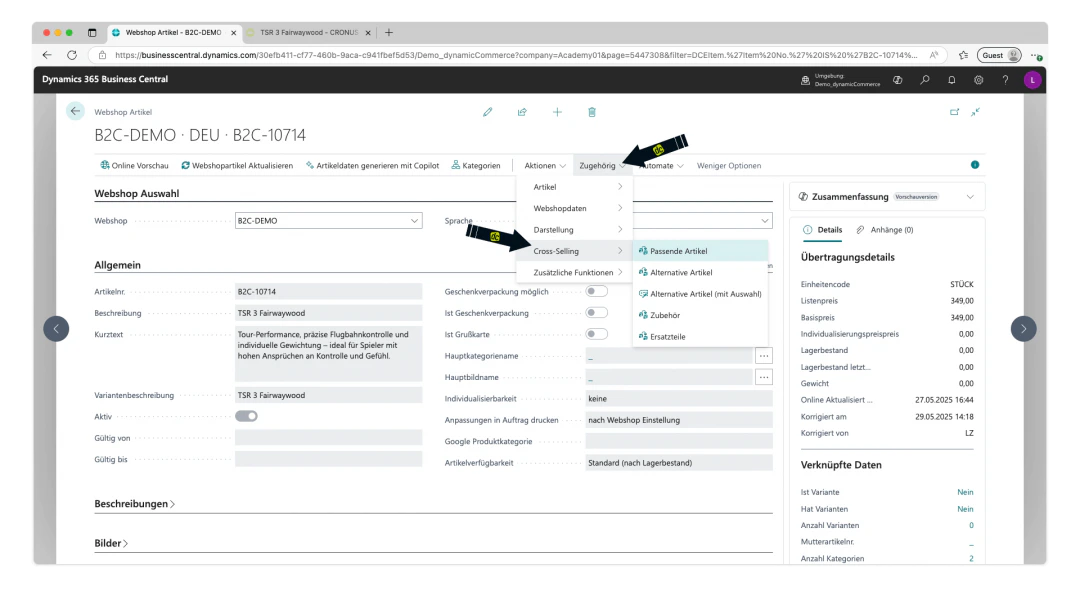
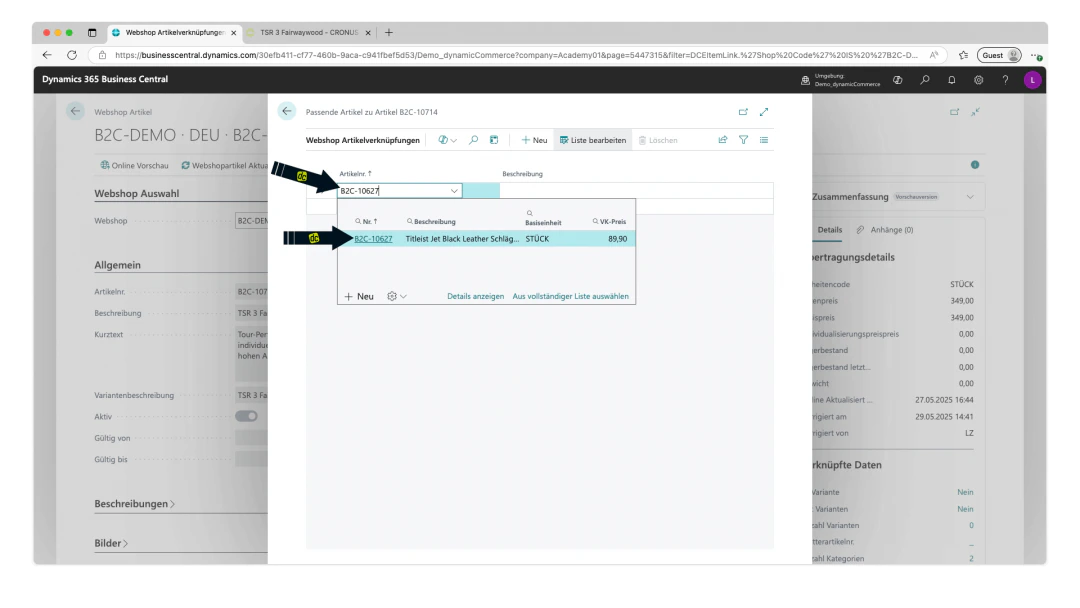
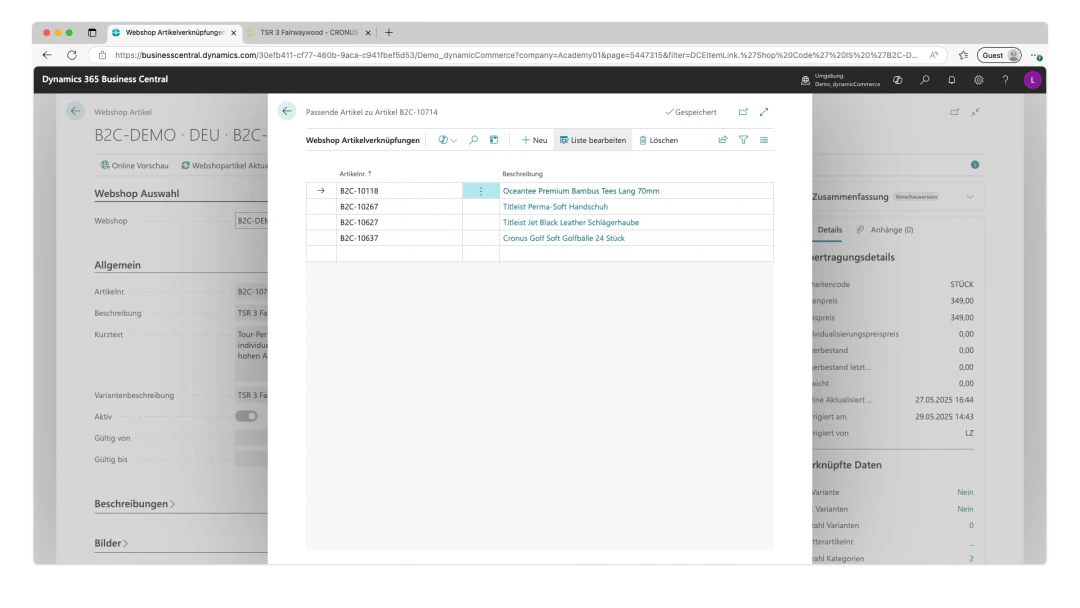
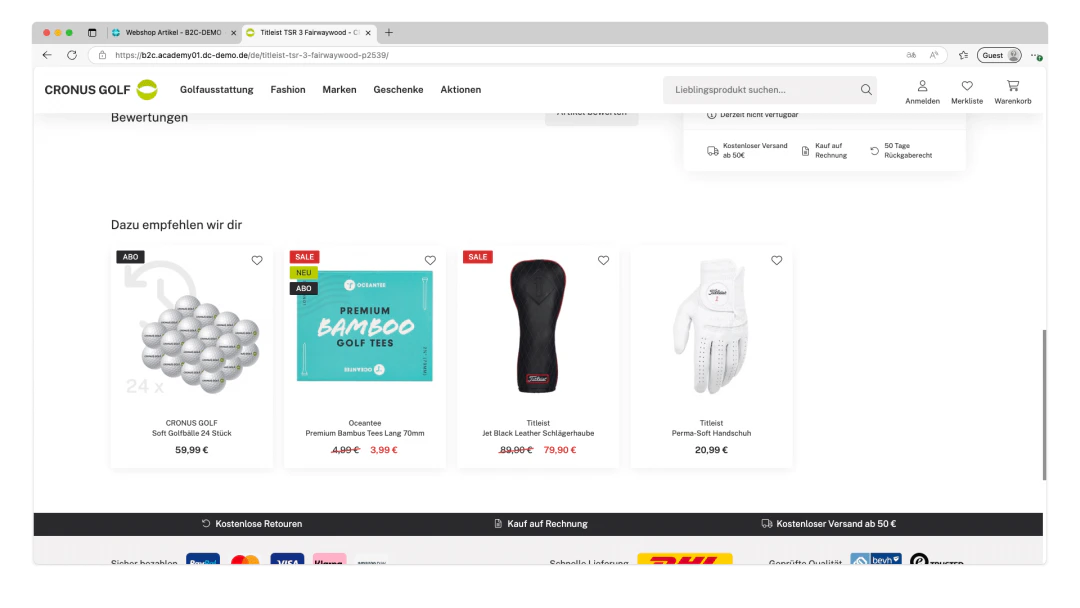
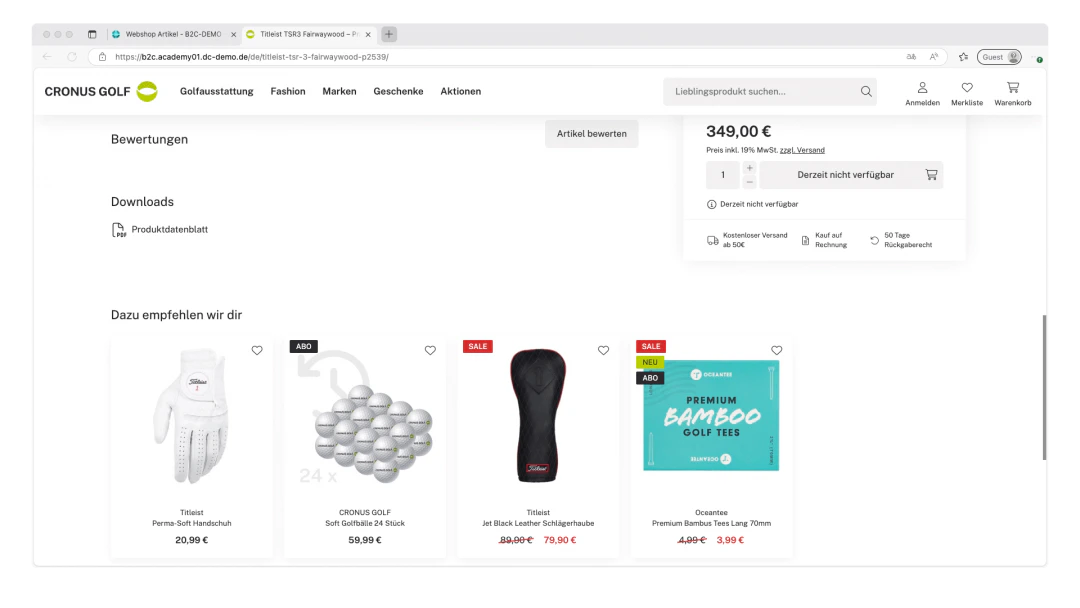
Next, you should also assign cross-sellers to the item.Cross-sellers are items that are offered in addition to a viewed or purchased item - usually because they fit thematically or functionally.On our webshop items, cross-sellers can be added to the item in the following ways:- Matching items: Products that go well with the current item and complement it meaningfully.
- Alternative items: Similar products that could be considered as a replacement or variant.
- Alternative items (with selection): These are alternative items that have a preview with an item image on the main item. The classic example of this would be color variants. We show you exactly how this works here.
- Accessories: Complementary products that extend the main item or improve its use.
- Spare parts: Individual parts intended for replacement or repair of the item.
11
Step 11: Update webshop item
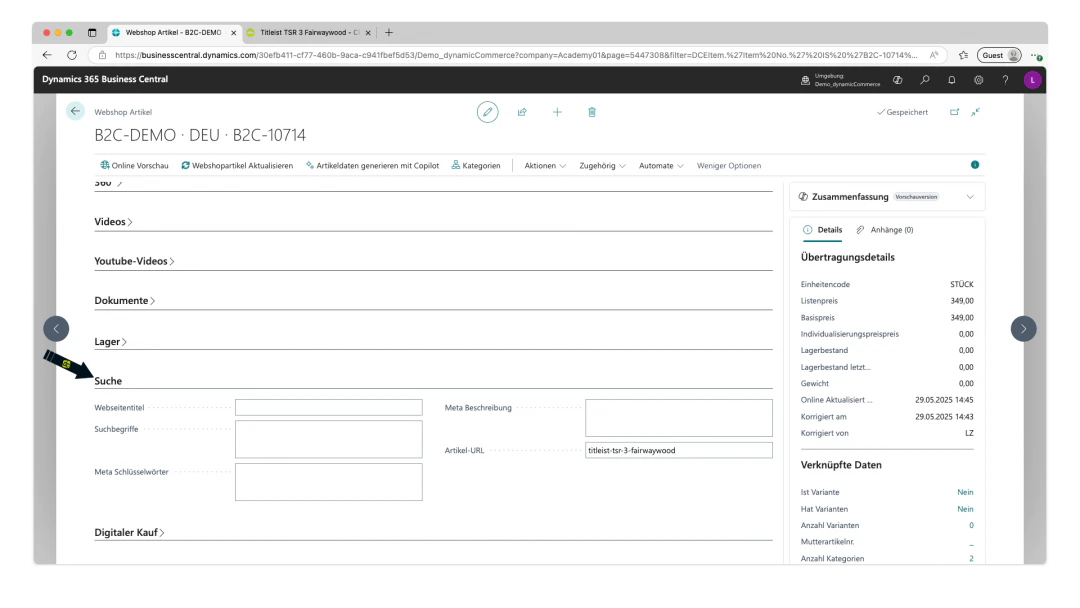
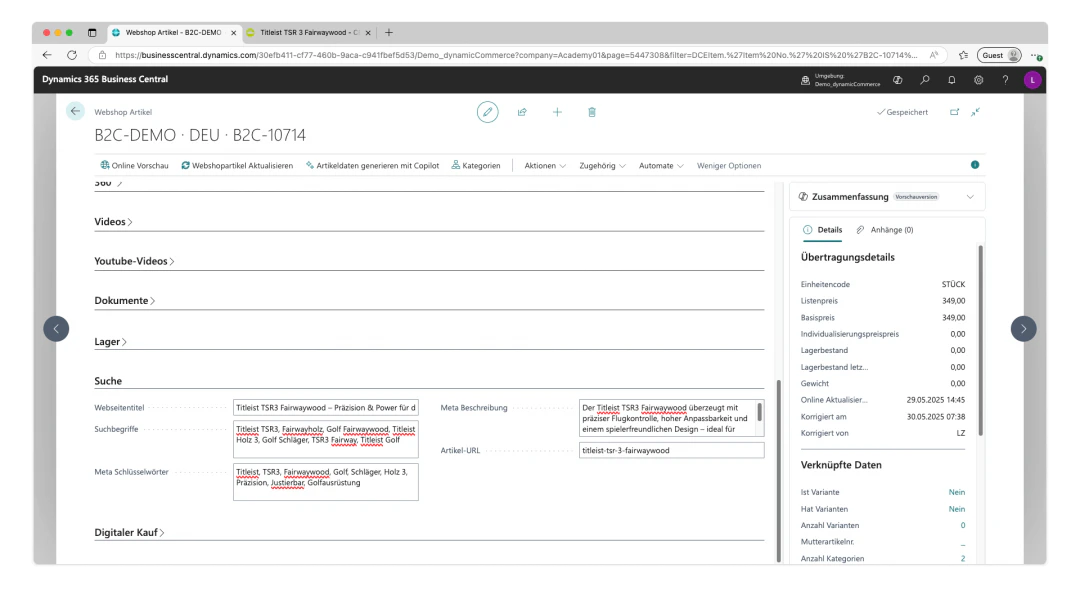
Now you should also maintain the metadata of the webshop item.This metadata is additional information that is not directly visible on the item page but helps search engines to better understand the content and display it correctly in the search results.This can be maintained directly on the webshop item card under the “Search” section.The following fields are located there, in which the respective metadata can be maintained as text:- Website title: The title that is displayed in the browser tab and in the Google search results - it should describe the content of the page concisely.
- Search terms: Relevant words or phrases under which the item should be found in the internal search or external search engines.
- Meta keywords: (outdated, but sometimes still used) Keywords that categorize the content thematically - today usually without influence on the Google ranking.
- Meta description: A short summary of the item that is displayed in the search results and is intended to encourage users to click.
12
Optional: Add videos to the webshop item
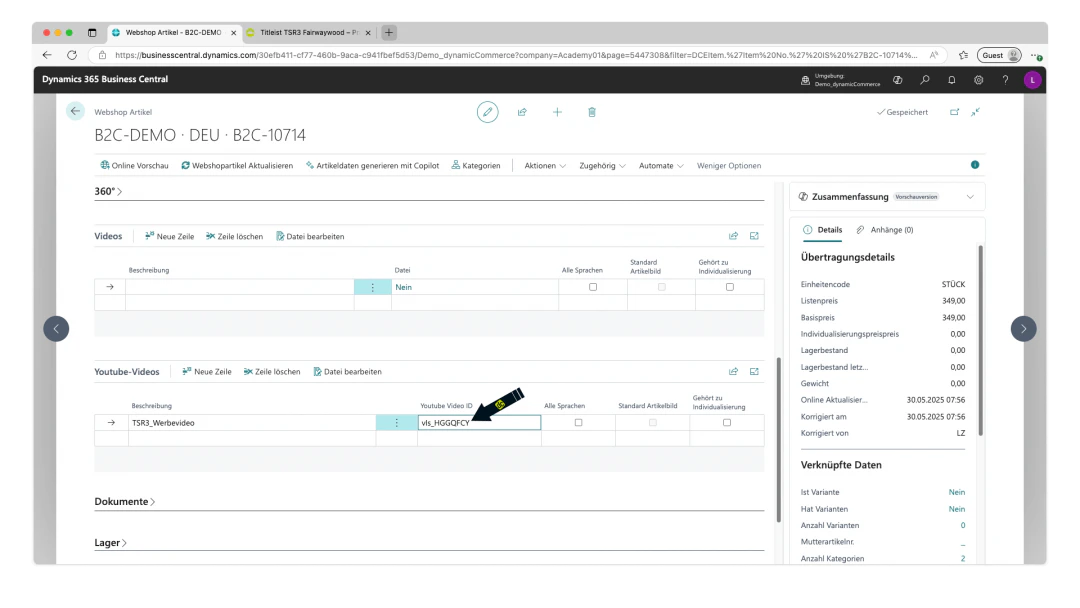
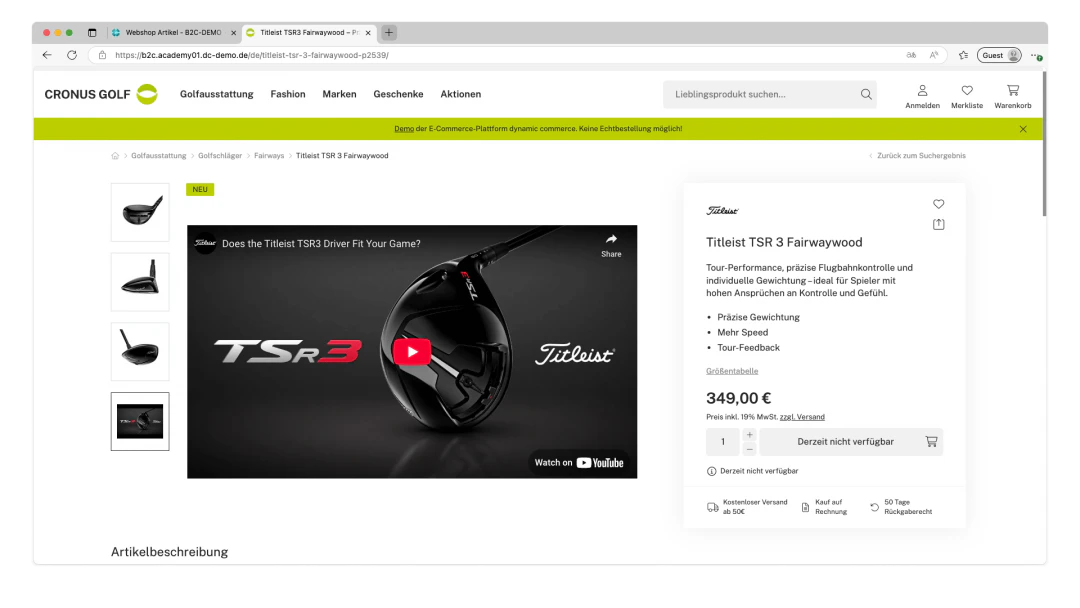
Optionally, you can maintain different types of videos on the webshop item under the “Videos” and “Youtube videos” sections.Normal videos are effectively maintained like images, with the difference that a video must be uploaded as a file.For Youtube videos, only a description and the Youtube video ID need to be maintained.The YouTube video ID is a short code that uniquely identifies each video. You can find it in the URL of the video after the “v=” - for example, in https://www.youtube.com/watch?v=dQw4w9WgXcQ, “dQw4w9WgXcQ” is the video ID.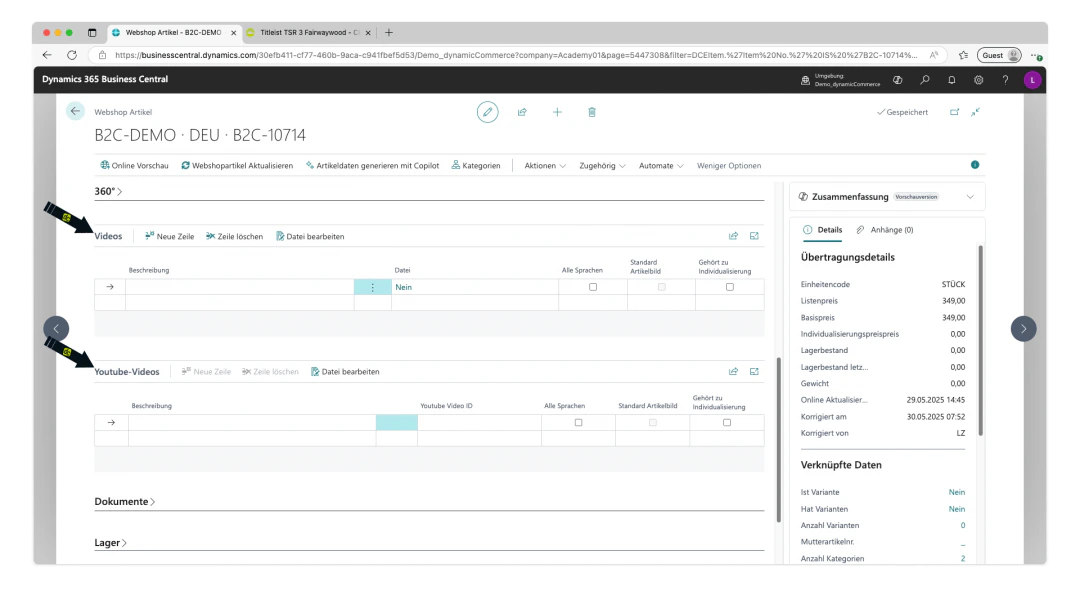
13
Optional: Add documents
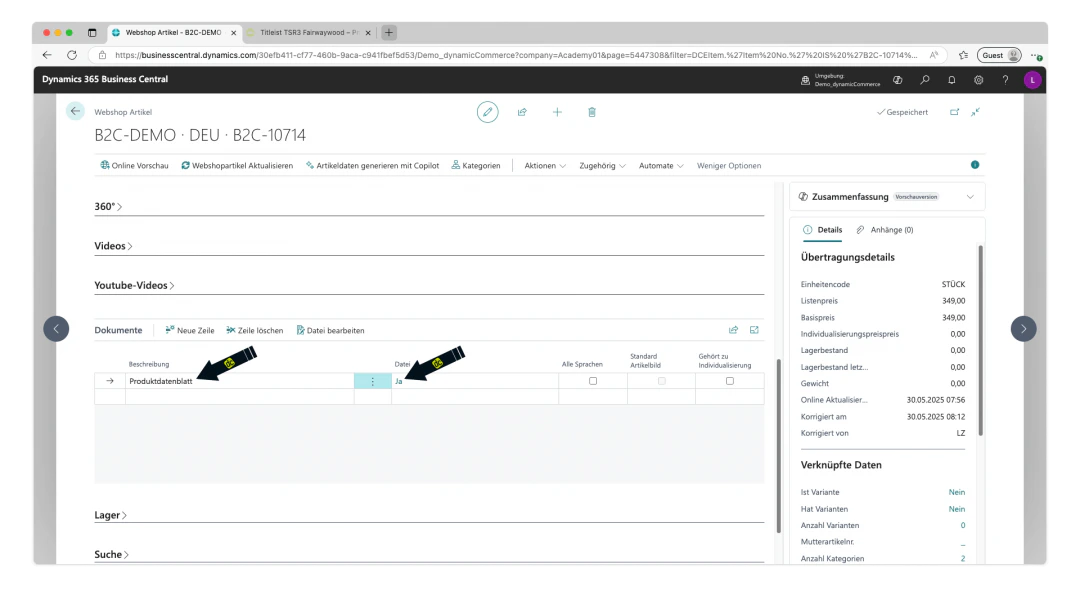
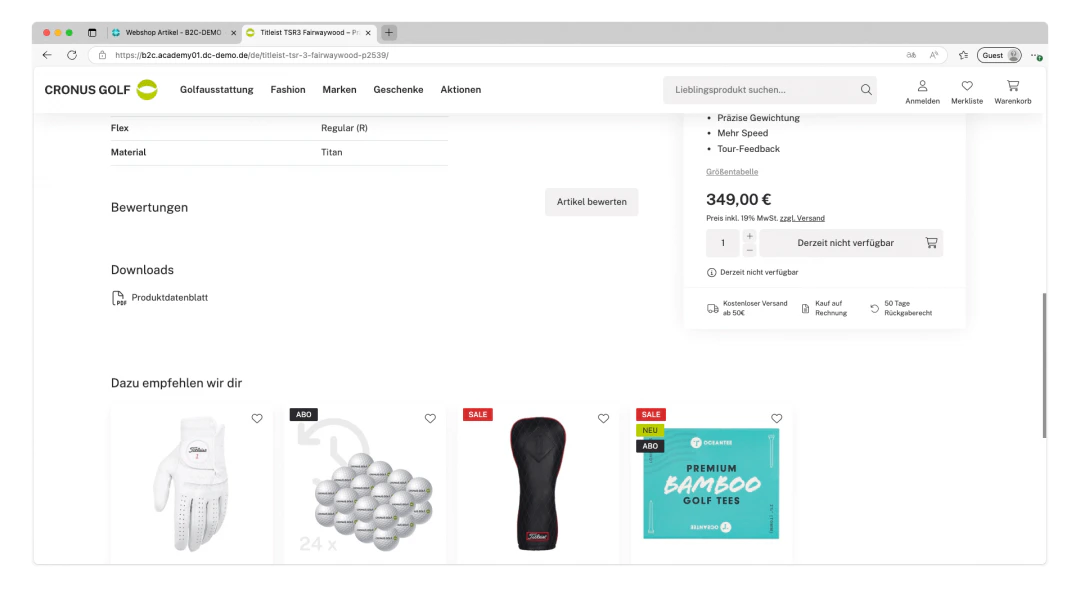
Under the “Documents” section, you can upload documents on the webshop item that visitors to the webshop can download. These documents are displayed on the item.For example, you can provide instructions, product data sheets, mandatory information for foods, or software drivers. The document function supports.pdf, .doc, .docx, .txt, .xls, .xlsx, .csv, .rtf, .zip, and .rar.To maintain a document, a description must be assigned as usual and a file must be uploaded by clicking on the “No” in the “File” column.In this example, we store a product data sheet as a PDF.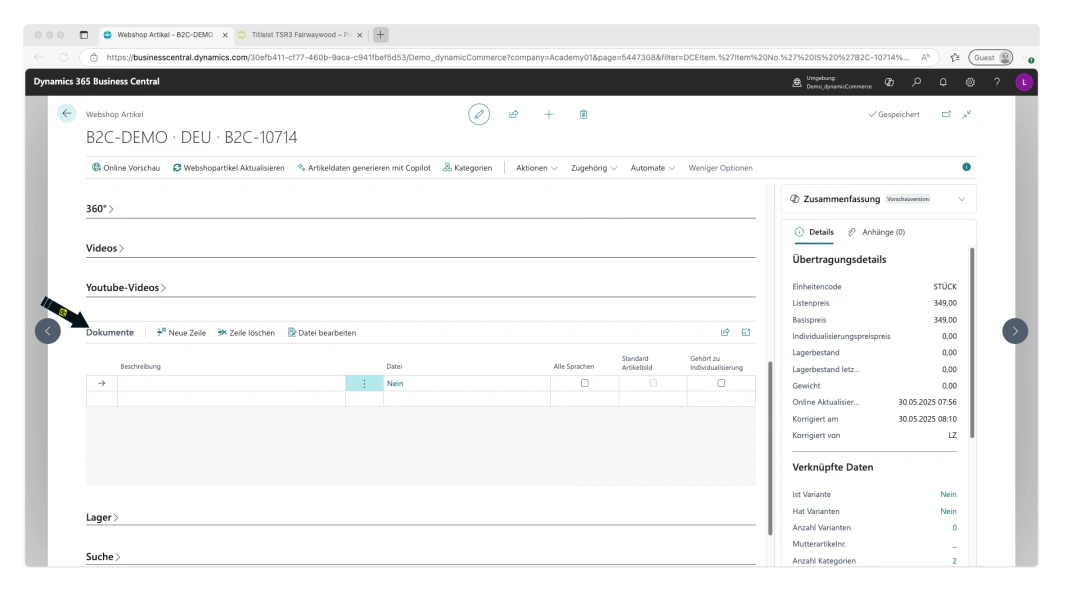
14
Step 12: Update webshop item
Last but not least, the webshop item must still be updated so that the changes and the newly maintained data are also visible in the webshop.In the ribbon of the webshop item card, click Update webshop item. Then close the confirmation with OK.The webshop item is now created and updated.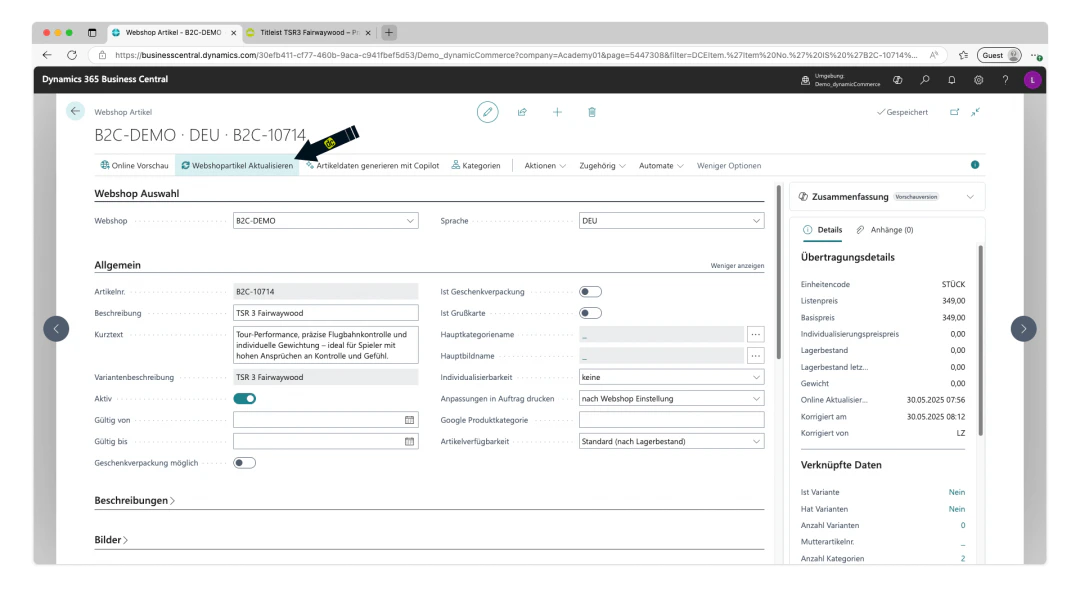
Related Topics
Set Up Webshop Categories
Build the category tree for the webshop.
Set Up Item Category
Structure item categories and attributes.
Set Up Item Permissions
Control item visibility per customer.